Category: The Internet

  • What AI Can’t Do

    What AI Can’t Do

    What can AI do?

    AI can tell you the best practices to apply to web content.

    But it can’t fumble around in a new job after having earned a college degree that’s only tangentially related to your duties. It can’t try out these best practices with uneven application, see what the audience responds to, what the search engine responds to. It can’t organically become an expert on a niche subject matter after talking to an enthusiastic engineer growing in power until it understands the kind of article you need to write to reach people and have it matter.

    AI can’t touch grass. But we probably need to all go out and do that. (Photo by Aleksander Fox on Unsplash)

    AI can’t take that growth experience to its next job, where it’s already ahead of the game by knowing what to try and where to start and how to tell its younger coworkers that they don’t have to get it right away. That ultimately they just have to keep trying.

    AI can’t go on a date and have a first kiss and find itself distracted in the following weeks after that magic moment, going through the motions of life and working on routine tasks only to drift back to that experience, that feeling in the pit of your stomach, the way your lips tingled and made it feel somehow real for the first time ever. It can’t wonder at a new experience, something that took you completely off guard when you thought you’d already had things all figured out.

    AI can’t buy the new product that everyone’s been raving about and then discover that while it has ten functions you don’t need, it doesn’t have the one function you want. But you can’t seem to admit that to anybody else, so you end up with a piece of tech in your house that gets sparsely used until it ends up unplugged, without batteries, in a drawer somewhere. It wouldn’t find said abandoned object three years later in a fit of inspired spring cleaning, digging it out of the drawer and carting it off to the local thrift store while looking skeptically at the hot new gadget.

    AI hasn’t tried typing increasingly specific searches into the search bar in an attempt to locate that one perfect tweet you saw years ago but neglected to download or screenshot. It hasn’t thrilled in the glory of saving a small piece of internet history from obscurity even though nobody else you know cares about this. The screenshot won’t sit in a digital folder somewhere only to pop up later and surprise you into loud, barking laughter. It can’t understand that weird form jokes on the internet take become a type of shared language and, in some ways, an odd form of emotional support in the modern age.

    AI can’t get a bad cold and find both its nostrils stopped up and its throat aching and feel that post-nasal drip at the back of your throat that signals a lingering cough is imminent. That even after the other symptoms have disappeared, you’ll lie awake at night and not even the strongest dose of Nyquil will do anything to stop it but it also doesn’t feel like a big enough deal to go see the doctor.

    AI can be funny in a programmed way, but it doesn’t know the feeling of being struck over the head by something so gut-bustingly hilarious that you and the person you’re with keep cackling until your stomachs hurt and your eyes are streaming and you both pull it together just enough to sigh but then you both sigh at the same time and that sets you off into fresh peals of laughter.

    AI has never lain on a too small, not-quite-comfortable mattress, arm pinned under the body of a sleeping child, itself in a half doze in the dark, feeling the warmth and comfort of someone so small and vulnerable who trusts you so completely and loves you without any complication. It can’t wrestle with the question of whether you should just fall asleep or try to extract yourself to do the dishes. What the dishes worth anyway against that soft, even breathing?

    AI doesn’t know the human experience. It hasn’t skinned its knee or held someone while they cried or felt a deep aching frustration at something not going the way it had planned. It doesn’t care if it gives you advice that hasn’t been fact checked or if you’re exhausted because your baby didn’t sleep or if you’re exhausted because your heart was broken or if you’re exhausted because you stayed up way too late reading a thrilling book.

    AI doesn’t know the beauty of a sunrise or the sound of your breath in your ears as you go stubbornly run the next mile or a song you love but forgot about surfacing again on the radio.

    It can’t do those things. But you can.

  • Content is about more than immediate rewards

    Content is about more than immediate rewards

    One of the things that is sometimes weird about being person who plans content within the context of SEO in the modern business world is that it doesn’t often fit within the expected frame of pumping out something as fast as possible to then show off the immediate and glorious benefits that made the company a gajillion dollars in five days.

    (Not that any thoughtful and consideration marketing plans should really operate on the above structure, but you know how it goes.)

    Quiet changes and small SEO endeavors are like the least sexy marketing on the planet.

    You put out an article, then you develop some other articles over the course of six to nine months and decide those should really become a content pillar. You do some analytics and some optimizations and your keystone piece of content slowly and steadily amasses views and conversions until two years later you have a pretty cool case study and something that ranks high and performs well in organic search.

    This is an exciting experience and can teach you a lot: Why is it performing best? Can you recreate it? Does it say something about what the audience wants or about how you crafted it? Is it worth optimizing again to get more traffic? How can it inform your content strategy in the long run?

    A delight for the too involved and deeply nerdy content strategist.

    Snail on green ledge, crawling down to lower surface.
    Let’s all just take a second, breath and reflect on our choices.

    But things can change fast in the business world and depending on the team you’re pitching to, it can be incredibly difficult to make the case for a thoughtful strategy that will take many hours to develop and then spend further time and money for careful crafting and building changes that you won’t be able to measure meaningful for a long time and a strategy that can only really be cohesively measured after a year. Maybe you work in house and you’re one of the only people who even knows what marketing is or the people at the top are calling the shots about where you should spend your time and who cares about content marketing. Maybe you work for an agency and your clients are more concerned about their next paid ad campaign and don’t want to invest time or money into the unsexy waters of SEO.

    Launching a new website is fun, publishing a new article and obsessively checking how many clicks it gets is fun. But maintaining the website, continuously optimizing it and building the structure and groundwork for more articles? Not as fun. Realizing that all the clicks you got on that article were essentially meaningful traffic that didn’t do anything for you? Ugh, least fun of all.

    It takes a lot of trial and error to figure out what works. And to figuring out which title is going to attract that most people. And what exactly you should be targeting to hit that first page of Google. And which CTA is going to convince people to buy.

    Basically, you have a hundred elements to test and each time you change one of them you have to wait long enough for enough people to see the change (or to wait for the bots to reindex the page) to see if that change did anything.

    Meanwhile, another team you work with created a viral TikTok.

    Okay, but does everyone know that you did a full analysis of how metadata is performing and plugged it all into an updated spreadsheet?

    Oh. Yeah, no. It’s fine.

    Ultimately, despite the fact that the world is becoming increasingly filled with more content and noise, it’s interested how a thoughtful plan and actually creative and helpful output make a difference. Sure, your AI can now spit out fifty articles. But what do those articles say anything?

    Careful planning and thoughtful work does something. Immediate returns are not the end all, be all (or at least, they shouldn’t be). What can we do to make an impact that can be measured over years and not hours?

  • Read more banned books

    Read more banned books

    It’s Banned Books Week! Or, maybe you’re reading this at some point in the future and it’s no longer Banned Books Week. Easy solution: Live your life like every week is Banned Books Week.

    In the past, I have often celebrated this auspicious occasion by reading a banned book. When I used to do a book podcast (um, I used to host book podcast called Novel Ideas, if you want to listen to some old book takes), my brother and I would go look up recently challenged books and read them.

    On the one hand, if you take this approach, you get to read a lot of great books! On the other hand, it’s depressing and predictable what’s going to make the list. If a book has LGBTQ+ content it’s like a million times more likely to be on the list. Also, books that deal with important but dark subjects get put on there a lot because the content is so shocking and terrible! But the point is to talk about a difficult subject? And how can we talk about difficult subjects without talking about them?

    It probably goes without saying, but I am not a fan of banning books or trying to dictate what anyone reads. When I was a kid, my mom let me read pretty much anything, even if it was out of my age range or above my reading level. (This is how I read The Fellowship of the Ring in the fifth grade and didn’t understand it at all and then read Dracula in the seventh grade and what the hell. My mom truly let me read whatever.) I got to experience some really cool books this way! I also read some stuff that went way over my head and I didn’t realize just how much until I read the books again at an appropriate age.

    Woman reading green book seen through seen through circular opening in stacked books.
    I was going to make a joke about someone knocking that stack over, but I don’t think anyone will ever want to read any of those books. (Photo by Ying Ge on Unsplash)

    I’d also like to say that this isn’t the sort of position where I don’t like it when certain books are banned but am okay with it in other contexts. I do not approve even when stupid books I don’t like are challenged. Reading a stupid book I don’t like has often made me annoyed, but I think there’s value in reading them nonetheless. Reading opens you up to new worlds and perspectives and helps you learn more about what you like and what you think. And if that book challenges your set worldview? Good.

    Reading dumb stuff you don’t like sometimes can help you clarify your thinking more. Maybe it helps you better articulate why you don’t like certain things, maybe it helps you think more critically about why you don’t like certain things. Whatever the result, the process is good and it helps you grow.

    What’s not great is looking at list of what a book contains and claiming that it’s going to corrupt young minds. That shit is tired. Scandalized by sex? The internet and television both exist and both of those things contain sex, so it’s not like teens will never hear be exposed to sex unless they read Lady Chatterly’s Lover or something. Violence is all over television too. The American Library Association points out that some of the most frequently challenged books contain diverse content. I mean…gay people exist and so do Black people and banning a book won’t change that.

    Also, can we please stop trying to ban books that teach children about their bodies and where babies come from? They need to get the information from somewhere and a reliable book with good information is much better than a parent stammering through a half-assed explanation. We all have bodies! It’s okay to learn about them.

    Reading new books will challenge you, will teach you to think about different people and points of view, will introduce you to new ideas, will generally make you more empathetic, more open, and more willing to embrace nuance.

    I’m incredibly biased because I love to read, but even if you think the above is a little too rosy, you have to admit that a good book can make you have a lot of feelings and a lot of thoughts and that’s a good thing.

    With all that said, I encourage you to read some banned books! Maybe some that have been challenged recently or are frequent targets. Maybe something like…

    Speak by Laurie Halse Anderson

    I had to include this because Speak was one of the most challenged books in 2020 and the thought that a whole swathe of people saw a book that is literally about a young girl trying to find the courage to speak out and then decided they wanted to silence it is really just a whole level of irony I wasn’t prepared for.

    The book does deal with sexual assault, so take that into account. But I remember when I first read this book in high school, it blew my entire mind. It takes the issue really seriously and shows the long-lasting effects of assault and how people’s responses to it often continue to harm victims.

    Apparently one of the reasons it was challenged was because “it was claimed to be biased against male students.” Umm, only those who commit sexual assault. Which, is probably an okay reason to be biased against someone. Maybe read the book next time?

    And Tango Makes Three by Justin Richardson and Peter Parnell

    This is a cute picture book features two male penguins at a zoo who adopt an egg and when the baby penguin hatches, they have a little family. The story is based around two real life penguins who did something similar.

    The fact that an adorable children’s book about gay penguins nurturing an egg and subsequently a baby penguin is the sixth most challenged book of the past decade really tells you something about society. Not sure what, exactly, but something.

    Read this one to your children out of spite and then feel a little warming in your heart.

    Fun Home: A Family Tragicomic by Alison Bechdel

    A graphic novel and a memoir, this book is a really interesting look into Bechdel’s family and her relationship with her father. It includes a couple surprising revelations about her dad and her own journey to discovering who she is.

    In case you haven’t guessed it already, the book is not called Fun Home because Bechdel grew up in a really fun home. But certainly one rife with secrets and frustrated desires.

    The Hate U Give by Angie Thomas

    Timely for a whole host of reasons and I’m sure it’s challenged for the exact reasons it’s relevant. I liked this book and thought it did a good job tackling a tough topic and making it relatable. The book is definitely YA and features some of those common YA tropes, but I didn’t mind that so much because of who the intended audience is. It’s a good entry point for adults too, though.

    This book also recently was made into a movie, which I didn’t see, so I can’t vouch for its quality. But the book is definitely worth checking out.

    Beloved by Toni Morrison

    This book is wild and dark. It has lots of metaphorical hauntings and one haunting that seems to be pretty literal. At times this one takes turns that will leave you scratching your head, but ultimately it faces the brutal history of our nation and grapples with how the past can cause ongoing trauma that people carry with them for a long time.

    Quick aside: I recommend reading Toni Morrison in general, but if you are an audiobook person, try to find one that she has narrated! Her voice is lovely and soothing and listening to her read her own work made a lot of the writing style come alive for me in a way it didn’t when my own clunky brain was trying to process it.

    Awakening by Kate Chopin

    In my junior year of high school we had the option of reading a couple different books, and I specifically chose Awakening because it had created such a scandal when it was first published for featuring a woman who cheated on her husband. Spoiler alert: This book is not lurid and contains no sex. It’s all implied and vaguely talked around. Seventeen-year-old me was extremely put out by this fact.

    Reading the book again years later, I was less annoyed by the lack of sex. Instead, I was struck by the fact that the main character had complicated feelings about her children, and I thought that was really cool. She’s allowed to be unhappy in her marriage, not because her husband is a terrible, abusive human being, but just because she doesn’t like him very much. And she’s allowed to be ambivalent about being a mother. Those are not things you get to see very often!

    Spoiler alert: She is not allowed a happy ending and gets punished for her transgressions. Thank goodness they don’t make us all walk into the sea when our children give us complicated feelings.


    This list is definitely not exhaustive. I’ve read other books on the banned and challenged lists and enjoyed them! I’ve read some books on those lists and not liked them much at all. Consider checking out these 100 most challenged books from the last decade. Give one a try. Or if you’re just looking for some books from different perspectives, you can see some of my recommendations for Juneteenth and Pride Month.

    It’s okay if you don’t like one. Or if you don’t want to read a certain entry. We can all choose what we want to read. And it’s okay if those things are different than what other people want to read.

    Have you got a favorite banned book? Let me know!

  • Some stuff I liked in August

    Some stuff I liked in August

    In the interest of continuing to produce content that adds to ever growing content pile that is the internet, here’s a new post! (Read my thoughts on the noisy world of content we live in if that’s your sort of thing.)

    One of my goals for this blog is to write thoughtful or thoughtful-ish pieces that fully explore something I’ve recently read or watched or listened to (like this semi-recommendation of The Count of Monte Cristo).

    But like anyone who has ever had to write an essay knows, having to start something thoughtful can be super daunting even if the actual practice of writing it isn’t that hard.

    So, in the interest of making things easier for myself, I thought I’d give a couple mini-recs based on what I’ve consumed this month. Short and I don’t even have to remember that far back! Double win.

    For your consideration…

    YouTube: Great Art Explained

    Three videos on the YouTube channel Great Art Explained
    Also, check out the Arnolfini Portrait episode! So good!

    I love a lot of channels on YouTube that feature smart people doing good research and talking about stuff at length. But the “at length” part can sometimes present a problem when I want to watch something less than half an hour long.

    Enter Great Art Explained. I just discovered this channel a few weeks ago, and I love it. Not only because I’ve been learning the context behind famous paintings but because the creator holds himself to 15 minutes or less. Unlike a lot of other great channels where the video lengths creep ever upward, these are stuck at a length of 15 minutes(ish). Perfect!

    Really all the videos I’ve watched so far are winners, but I really recommend the one on Judith Beheading Holofernes painted by Artemisia Gentileschi. You get historical context and actual art analysis all wrapped up in one. Good stuff.

    Podcast: Maintenance Phase

    Cover art for Maintenance Phase
    Dr. Oz has a bad show, you guys!

    Co-hosted by Aubrey Gordon and Michael Hobbes, this podcast focuses on “Debunking the junk science behind health fads, wellness scams and nonsensical nutrition advice.” It is a delight!

    The hosts have so much fun together and really provide an invaluable service by diving into things you take for granted or don’t think about. Their early August episode on the BMI blew my mind.

    Plus they are funny and usually keep it to about an hour so it’s just a good listen all around.

    Newsletter: Butt News

    Logo for Butt News, a newsletter by Lindy West
    I mean, you should be sold based on the logo alone.

    I subscribe to several amazing newsletters that I will probably eventually try to force everyone to read, but the one that has brought me the most joy in August is Lindy West’s Butt News.

    I’ve been a Lindy West fan for awhile and am so delighted I can read her writing regularly again.

    Her movie recaps are hilarious and my favorite end cap of the past few weeks. (Bonus: if you read a few of those recaps and like them, then you should buy her book Shit Actually, which is full of movie reviews/recaps and caused me to laugh out loud multiple times.)

    Don’t you want someone trying to figure out why the hell the characters in the first Fast and Furious movie are so obsessed with tuna making their way into your inbox every week? Yes, you do.

    TV Show: Virgin River

    Title card for the Netflix show Virgin River
    Come for the ridiculous human drama, stay for the gorgeous shots of the the Pacific Northwest.

    Virgin River is just a gentle, warm blanket you can wrap around yourself. In this Netflix show, a big city nurse moves to a small town in the Pacific Northwest following the tragic death of her husband and the curmudgeonly doctor who lives there doesn’t want her help.

    Also, the local bar owner is ruggedly handsome and they have good chemistry. What might happen there? (You know what might happen there.)

    This show hits the beats I expect in the best way. It’s full of drama, much of which could be solved by people communicating better, some medical drama and cases, and multiple romantic threads. It’s just a good time. And sometimes the characters have inexplicably dress up like lumberjacks or line dance or whatever.


    That’s what I’ve got for you this month! For what it’s worth, I almost included Ever After, but I love that movie enough to write a long article about it. You know, one of these days.

  • Making content for the sake of making content is just noise

    Making content for the sake of making content is just noise

    A flip switched at some point in the last ten(ish) years and now the world is full of content. Bursting with content. All companies are trying to create content. There approximately five dozen streaming services crammed to the brim with content. Videos and newsletters and podcasts that you love and enjoy that used to be made and written by people are now made by “content creators.”

    Everywhere you turn, content is fighting for your attention. Do a simple Google search and you’ll find dozens of pieces of content in multiple formats all fighting to tell you about it. Pretty much anything you can think of probably has some sort of content created about it in some format it.

    It’s sort of exhuasting.

    Partially because there’s just so damn much of it and you’ll never be able to consume it all.

    But partially because most of the content that surrounds you is just noise.

    Three women sitting in front of a laptop pointing at the screen
    “If we put three people on one laptop, we can produce three times the content!” (Anyone else get an uneasy pandemic feeling about these people sitting so close to each other? Photo by John Schnobrich on Unsplash)

    The early days

    A quick internet search tells me that Bill Gates is the one who first wrote the cursed phrase, “Content is king.” I have no idea if this true. Probably someone else wrote it first but Bill was the first one to publish it in a forum where enough eyes landed on it to give him the credit.

    Classic billionaire stuff right there.

    Companies creating actually valuable content used to be a novel idea. The old way of marketing is creating cool ads that capture people’s attention (I guess still a modern way of marketing too).

    Advertorials have existed for a long time, but I don’t remember sponsored content from my childhood ever being worth reading. Unless you really wanted to buy a fancy watch and needed 500 words to back you up, I guess.

    The internet really shook things up. As search engines got smarter and started finding actual useful articles, savvy marketers learned that writing content with the right keywords got them in front of eyes. I haven’t been around since the early days, I’ve only read snippets of other people’s experience, but my understand is that back in the day, creating content was enough. So few people were doing it that by virtue of doing it, and following a couple of the rules, you got eyes on what you created.

    And it worked!

    Thus, content marketing was born? I don’t actually know. I’m making it up a little. If not born in that moment, then certainly popularized or recognized as valuable on a more widespread scale.

    Drowning in meaningless words

    Once people realized they could make content and gain traction with it, they started doing that. Remember the heyday of blogs? Remember LiveJournal?

    Companies also jumped on the content train, bursting forth with anything and everything to cash in on those sweet, sweet clicks.

    A lot of places skip an important consideration, though. For your content to actually do something, it has to provide value to your audience.

    If you write about thing xyz because your competitor wrote about xyz and it get tons of clicks and pageviews, then great! You won! Right?

    Not necessarily. You can generate a lot of traffic on an article from people would never buy your goods or services. Just because someone else wrote about it and got lots of views, doesn’t mean you automatically need those views. A lot of businesses see they have a lot of pageviews and call it a day. Successful content!

    But you have to consider if those views are valuable. If those people are going and looking at your other stuff, if they’re subscribing or if they’re buying your stuff.

    If they read that one thing and then leave never to come back?

    Not successful content. Just noise.

    Another pitfall is the company that wants to create something valuable that looks great and has good information. They create a beautifully crafted white paper with design and proofreading and everything!

    Then nobody downloads it.

    Just because something is done well and looks good doesn’t mean it’s valuable to your audience. Your white paper can be pretty as all get out, but it doesn’t mean anyone wants to download it.

    Your content needs meaning to be worth something. It needs a purpose. It needs a specific voice. Otherwise you’re just contributing to that flood.

    The danger in appealing to the common denominator

    Having a specific voice can be dangerous, some might argue. Because if you’re targeting a really specific group about a really specific thing, you don’t get all the clicks. And you need those clicks! Those sweet, sweet clicks.

    Or, for TV, riding that line to generic town is a super lucrative way to do business. Have enough of a personality to be considered quirky but don’t do anything that actually pushes the envelope and you’ll end up with content that can be internationally beloved! Congrats!

    The consolidation of entertainment so that certain companies own all the huge properties has helped to create much more homogenous content. This means that even as we get more of it, it’s less and less different from each other.

    The really big companies don’t care about this. They like the safe bet. They know several million people are going to watch whatever superhero thing and that they will make a profit from it.

    That’s a fine goal for a company who only cares about making money for the content it produces.

    I find it interesting that several times a year TV shows and movies seem to pop up that take a bunch of people by storm. Not as many people as will see, say, the most recent Marvel creation, but enough to make various outlets sit up and take notice. I’m thinking Russian Doll here and Knives Out, which really took everyone by storm for a few months there.

    Now Knives Out is a star studded cast, but it’s an original screenplay! On a middling budget! People lost their shit for this movie! (Myself included.)

    Russian Doll spawned a lot of thinkpieces and recommendations and absolutely entranced a ton of people. (Myself included.) It came from a real specific point of view and stayed true to itself. It didn’t care if everyone wanted to watch it. And then…everyone wanted to watch it.

    These kinds of examples always make me laugh. Like we all rediscover that we like original work trying to do something new. The seventeenth installment of a franchise can be good, too. But it won’t set your hair on fire like Russian Doll.

    What is your purpose?

    Whatever kind of content you’re creating, you should ask yourself what your purpose is. It doesn’t have to be views or clicks or monetization. But you should be creating for some reason. (It’s okay if that reason is because it makes you feel good! Your hobby doesn’t have to be a side hustle! It’s okay to create art for art’s sake!)

    My purpose for writing this blog is because I want to write. I need a creative outlet, but I don’t have the time or energy to do big writing projects at the moment. And I’ve been thinking about blogging for awhile. I like the idea of exploring thoughts and topics through my writing. If someone visits, I like that they get a picture of my interests and who I am. I don’t need a ton of people to read this. (Although if you are reading this, hi! I like you.) I don’t really care if I show up on search engines. I just want to show people who I am and maybe you can find something here that you connect with or that entertains you.

    When companies produce content, they usually want to get some kind of return on it. People buying their stuff, taking the next step on the customer journey, gaining more awareness.And you don’t get that from just slapping together whatever random stuff appeals to you as a human. That purpose and approach works for someone goofing around on a personal blog. Not so much if you need views and conversions.

    I’ve seen a couple mentions lately of AI being developed to write content. This is only possible if the robots are writing the same old crap from the same old perspective. It only works if companies want to spew out a heck of a lot of content. I’m guessing that if wielded by a smart person, the AI can produce decent results. I’m also guessing it’s going to make the content problem a whole lot worse.

    When you let people be thoughtful and funny and deliberate and voice what they think, you’re not just part of the chattering crowd of content anymore. You’ve made something better than that.

    And that is always going to have its value.

  • How useful is a cover letter anyway?

    How useful is a cover letter anyway?

    Looking for a job is pretty stressful and part of that stress is generated by applications. After all the hours you spend crafting a perfect resume and a portfolio and other materials, all you want to do is go find things that look interesting, attach your carefully curated information, and then go spend your time elsewhere.

    But it’s not so easy as all that. Sometimes you have to fill out forms, either entering information from scratch or editing autofill forms that are a garbled mess. Sometimes you have to answer questions about availability and salary expectations and years of experiences. And sometimes you have to write a cover letter.

    *cue screaming*

    A man and a woman high fiving each other in front of a laptop in an office space.
    “I need a high five after reading the most brilliant cover letter ever!” What happens every time a company reads my application, probably. (Photo by krakenimages on Unsplash)

    I have never liked writing job application materials for myself. And the cover letter is one of my most dreaded. For me, it’s impossible to feel good about myself while I’m writing the cover letter. Sometimes I am a little proud of the final result, but I always feel like an exposed dork once it’s been sent off.

    Talking about yourself and your accomplishments is hard enough. Doing it in an engaging and meaningful way is difficult. Then, when you don’t get asked for a first round of interviews or receive a form email politely rejecting you, you have to wonder…did anyone read that cover letter in the first place? Are you screaming into a void populated by robots and keyword checkers?

    How social media made my blood pressure rise (this time)

    I started thinking about the usefulness of cover letters recently as I always do when job searching, and then I saw this post on LinkedIn about whether cover letters are necessary.

    LinkedIn post by Joel Lalgee polling others on whether a cover letter is worthless.
    I voted yes so I could see the results and because I was feeling salty at the time.

    I thought people might have some interesting insights on how useful cover letters were, so I dove into the comments. And…yikes.

    A bunch of recruiter and hiring manager types talking about how cover letters were absolutely necessary and good (which is fine). Others discussing how a cover letter automatically moves someone’s application to the top of the pile. How they always moved applications with cover letters to the top of the pile but never actually read them.

    I’m sorry, what?

    Granted, there are probably plenty of job searchers who just stick a copy/paste cover letter on a resume and move on with their lives, but come on! To just say, “Well they wrote one so they probably care more than everyone else” and then never read them? I don’t like this.

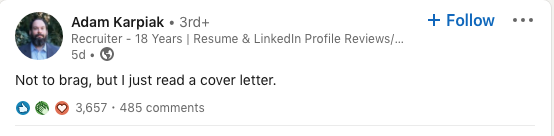
    As if reading my mind, LinkedIn then recently showed me this other post:

    Screenshot of a LinkedIn post that reads, "Not to brag, but I just read a cover letter."
    More of a humblebrag, I think.

    I actually find this post hilarious (the author is obviously tongue in cheek here), but it is depressing that the idea cover letters are never read is so pervasive this guy can make a successful joke about it.

    Curious about what the people in my life think about this stressful piece of writing, I took to social media.

    Conducting some important and scientific research

    When I posted a Facebook status asking people what they thought about cover letters, I had no idea the variety of responses I’d get. It turns out my friends are thoughtful humans and all of them had great stuff to say. I had a lot of responses from people who’d hired others and their thoughts on a cover letter’s usefulness.

    Some of the points made about how cover letters can be useful:

    • If you are applying to a writing job, the cover letter can act as a mini writing sample.
    • If you are making a career change or your resume doesn’t quite match the position, you can fill in the blanks and tell your story.
    • If your resume isn’t quite as strong but your cover letter is great, that can bump you up the pile.
    • If the candidate pool is largely recent graduates without much experience, cover letters can help differentiate.

    Basically, a good cover letter can help highlight who you are and if the hiring manager reads the letter, it helps them get to know you better and improves your chances.

    When cover letters are not so useful:

    • For jobs where writing skills aren’t that necessary or where it’s much more important to have specific certifications and qualifications that can just be listed on a resume.
    • When you have a portfolio that highlights relevant work for the position and gives better context than a cover letter would.
    • When the positions are more entry level and there isn’t much to say about them so writing a cover letter is kind of pointless.
    • When they contain errors that make the application weaker (in this case, no useful for the applicant).

    I had a few people arguing that for writing/marketing positions they wanted cover letters and others who said they’d rather see a portfolio and writing samples for those positions instead of a cover letter. And finally one friend made the brilliant suggestion that if you want a writing sample, consider giving a writing prompt instead of asking for a cover letter.

    I want to note that all the above points are great but they are coming from hiring managers. The comments from jobseekers largely said they’d rather not write them. I got a great point that requiring cover letters can be too high a barrier for some applicants and cause extra stress for people who are neurodivergent. Should they pretend to fit the ideal candidate role to get an interview? Is this disingenuous? Will it end making them a bad fit?

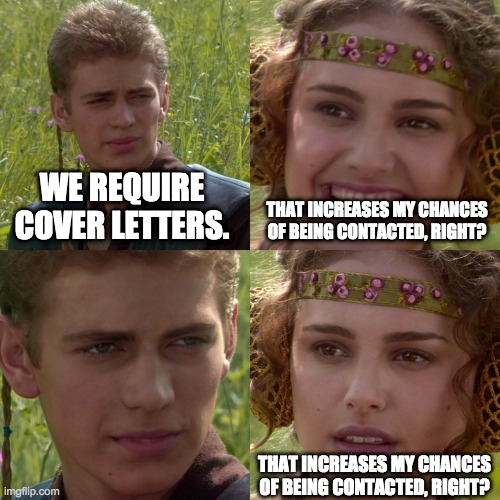
    A couple people commented that they suck to write but seems like including one increases your chances of getting contacted. Right? Right?

    My own cover letter results

    Because I’m a huge nerd, I kept track of my current job search in a spreadsheet. I noted the job, dates applied, when I heard back, and whether I wrote a cover letter.

    So out of 19 full-time jobs I applied to, I wrote cover letters for six of those positions. A couple where I didn’t write cover letters required short answer questions, and those took enough time to answer, I figured they didn’t also need a cover letter. I got asked to eight phone interviews. Of those eight positions, I had written cover letters for three.

    Which I guess means I had a higher success rate for jobs I didn’t write one for?

    Part of this is because I tend to write cover letters for jobs that are more outside of my wheelhouse or are maybe a touch beyond my experience. I’m trying to provide the extra context to show I’m a good fit. But I get weeded out for whatever reason.

    This is fine, but it can be sort of demoralizing. Some of the cover letters I worked hardest on, tried to be the most clever with, tried to really show who I was and what I could do got met with nothing but a rejection email. If that means my experience simply wasn’t there, I get that. But then did the cover letter really do anything?

    I had one job interview this time around where the interviewer referenced my cover letter, and I was sort of shocked. I don’t know that I’ve ever had that happen before. It was pretty cool. At least I know that they read it!

    Why I’d still rather not have to write them

    I get that a good cover letter can help make your case. I do.

    But writing a good cover letter takes forever. I carefully read the job description and pull out the bullet points that I think are important or that I have good examples for, leaving the points that are covered well enough on my resume. I go to the company website, see what makes them tick, see if they make any points that fit hand in hand with my own experiences. Then I try to craft the letter telling a story about why I want the position, how I’ve done work and have skills relevant to what they’re looking for, making sure to hit those relevant bullet points. After I do that, I have to go back and edit myself, condense my points, make sure everything fits onto a single page. Then I have to read again for proofreading purposes.

    This whole process takes roughly an hour, sometimes more. Factoring in the entire application experience, applying to one job can take up to two hours.

    That’s a long time! Especially because I am cramming in my job applications at night after the kids are in bed, after I’ve washed bottles and prepared things for daycare, sometimes after walking the dog or cleaning dishes or folding laundry. If I spend every weekday night doing nothing but applying for jobs that require cover letters, I might get in five applications over the course of a week.

    Might.

    The only reason I was able to apply for the number of jobs I did this time around was because I wrote cover letters for fewer than half the jobs I applied to.

    And a couple of the ones I tried hardest on yielded no results.

    There are plenty of reasons a cover letter can be helpful. I understand why someone might want one from me, especially because I’m often looking at content jobs.

    But I’d still like to not have to write one and go to bed thirty minutes earlier instead.

  • SEO is like an onion

    SEO is like an onion

    Disclaimer: I did absolutely no keyword research to determine whether referencing Shrek when talking about SEO would gain me organic traffic.

    SEO has layers. So. Many. Layers.

    At first blush, it doesn’t really seem like it. Do whatever makes Google happy and set off on your way. You’ll be just fine!

    Three parts of a sliced red onion, showing off the layers inside.
    Behold: the SEO onion. You’ve got keyword research, link building, site maps, content clusters, crying silently, and data analysis. (Photo by Avinash Kumar on Unsplash)

    That’s how I felt when I first started optimizing content for SEO. As a bright-eyed little achiever, with the guidance of some really smart coworkers, I felt like I had a handle on the whole thing. I knew to write and check for keywords! To write headers and decks and optimize image size and write a caption. I could go look at how well an article performed to determine topics readers wanted. And I was taught repurposing by an awesome group who always looked for every which way content could be twisted and turned to take them to their full potential.

    I confidently strode into my next position. I understand SEO, I thought.

    Then I didn’t.

    SEO walks this interesting line for me and I tend to flop over either side of it on any given week. On some weeks I think, yes, SEO is common sense. Just write the best content you can and then you’re done. Other weeks I look at technical issues and the data and my brain falls out of my ear. One day I’ve reached the center of the onion, if you will, and the next, I realize I’ve only peeled back the outer layer. 

    I look at my efforts and the numbers with complete uncertainty. Does anything I do make any difference to our audience at all? Do I know how to look at customer journeys the right way? Are the numbers trending upward? Do I even know what a number is?

    While Socrates was super annoying a lot of the time, he was onto something when he said, “I know that I know nothing.” Anytime I start really diving into a subject and learning more about it, the more I become aware of all the things I don’t actually know. It’s the college freshman syndrome. Take your first social science class and the world suddenly makes sense! Take your sixth one and you realize just how dang complicated people are.

    SEO is a lot like this. On the surface, SEO makes sense. It really does. Clear as could be! Write compelling, helpful content. Target topics and keywords that people search for. Make sure the information is accurate and up to date. Include CTAs. 

    Right? Clear. Straightforward.

    When I think about it in that way, no problem. I have a clear vision of what I need to do.

    But then everything becomes weird and labyrinthian. Even if I’ve read ten articles on a topic and attended five sessions on that same topic, I can walk into session six and halfway through go, “Ohhhh. Yes! It’s all so clear to me now!”

    Why does this happen? Do I have the memory of a mayfly? (I mean, yes, but still.)

    It’s all about peeling back the layers.

    It’s the same problem I have with my weekly to-do list. I write down five things I need to do. Five tasks? No problem. I’ll be done by Wednesday.

    Then, on Friday afternoon, my hair is standing straight up and I’m frantically trying to get out the last thing of the week and I go to look at my list and somehow I’ve only checked off one-half of the first item?

    One of my former managers helped me break down this down once when I told her I felt like my productivity had tanked. She pointed out that the problem wasn’t my drive but the list itself.

    If item one is “Write and post an article,” it seems straightforward enough. But it doesn’t take into account all the tasks you need to do: research the topic, gather the information, talk to an expert, write the draft, go through revisions, check for keywords and headers, find and the refine the images, decide on internal linking and CTAs, and on and on and on.

    Didn’t get the first task done? Maybe you actually got the first 17 of 25 steps done. 

    This is where SEO comes back in. You look at your plan and decide to improve and target keywords.

    Easy. All you have to do is decide which keywords to target. Determine what resources you’re going to use to research keywords. Who you should ask about their input on company goals. On topic goals. On keyword goals. Does anyone even know or do you need to do it yourself? How many team members can help you? What’s the timeline? Do you have an idea of the number of keywords you want to target, what you’re currently ranking for, a posting schedule, a content calendar? How soon do people want to see results and does the organization even understand what those results mean?

    Whew. This is the largest onion known to all of history.

    The journey continues and somehow as you peel back the layers, you learn more and get better. The questions that you answered last month make next month’s tasks less daunting. The plan starts shaping up. When I look at numbers from last year and numbers from now, I can really start to pinpoint what’s working and what we can do more of in the future.

    I’m reading the newsletters and attending the sessions and continuing to try new things.

    Today, I’ve got this.

    Tomorrow, I’ll know that I know nothing.

  • Those who stop doomscrolling are probably still doomed to repeat it

    Those who stop doomscrolling are probably still doomed to repeat it

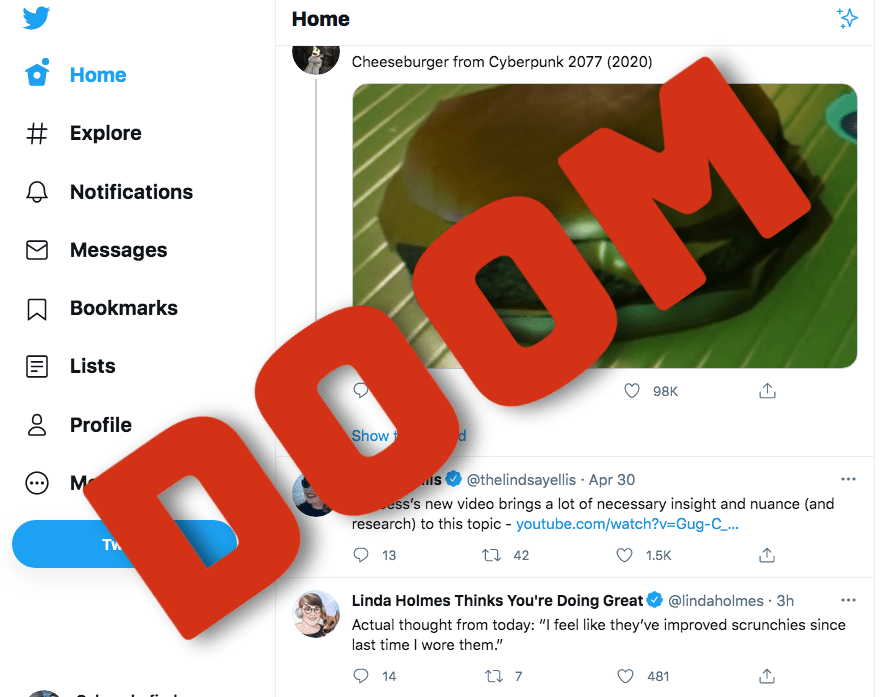
    I just logged in to get this screenshot. I SWEAR. (Thanks to Visual Watermark for the text on image assist.)

    I quit Twitter a couple weeks ago.

    Again.

    My relationship with Twitter has often been unhealthy (a common refrain of Twitter users), but during the pandemic, it really ratcheted up in terms of being a life sucking source. I could not stop doomscrolling. Continually glued to all the absolutely horrendous news about politics, police violence, widespread protests, the fact that California was on fire, just all of it.

    There were times when I thought or said out loud that I needed to stop. Having the internet prove to me every day that the entire world was an absolute dumpster fire was not really the most calming habit I could have picked up during a stressful time. It also made being pregnant real weird. (Even weirder than being pregnant during a pandemic was already.)

    I officially logged out a few times and managed well for a few days or a week at a time. One time I had successfully left Twitter and then Ruth Bader Ginsberg died a month before a national election. When the election itself actually happened, I stayed off all social media for a few days because my anxiety had already reached such a peak I didn’t think I’d be able to survive it. Then, when the votes started suggesting that the results wouldn’t be disastrous, I got back on to celebrate.

    Sometimes there is good stuff on Twitter! Nothing makes me laugh out loud quite like an absolutely bizarre tweet or meme that you only understand when the Twitter brain worms have fully taken over. Because I am officially an Old, and will never download TikTok, I got to see some of the best of TikTok through Twitter. This particular dance to “Rasputin” by Boney M. for example. So delightful!

    The less pleasant aspects of the platform, though, started to outweigh the other stuff. Dunking stupid tweets and dogpiling people seems to be Twitter’s favorite pastime. And although I hardly ever tweet and am too scared to voice opinions to become the Twitter main character of the day, the ghost of that threat seems to loom over all interactions.

    Piling on can be fun in the moment, and it can often reveal truly bizarre intersections of humanity (the most recent examples being Bean Dad and the Cinnamon Toast Shrimp Guy), but it finally started to dawn on my that this meant all my feed was breeding was negativity. Everyone is criticizing everyone. Either because they won’t open a can of beans for their daughter or because people are taking the bean thing way to seriously or because nobody can just have fun on the internet anymore or–

    Even all this might not have been enough to do it. Social media addiction is real and so is starting the doomscroll anytime you have a free second.

    But I had a second kid in December and went back to work in March. I’m up for an hour in the middle of the night most nights. My sleep is pretty destroyed and my days are an absolute blur of taking care of children, trying to productive at work, cramming in a boatload of chores, and then collapsing in an exhausted heap so I can sleep for three hours before the baby wakes me up.

    Most nights, I try to squeeze in a tiny bit of personal time before the exhausted collapsing part. Read a little bit, watch a short show, have an actual conversation with my husband. When Twitter was how I spent my personal time, I got sucked in for far too long, which was then further destroyed my already terrible sleep schedule.

    It all came to a head and I logged out. It’s been two or three weeks now. (I honestly can’t remember just how long because time means nothing these days.) I miss the memes and the goofiness somewhat. But I’m also getting a little more reading in. If I pick up my phone mindlessly, I try to open an ebook or put the phone back down. I can’t marvel at hot takes that truly bend the fabric of the universe, but I can get to bed thirty minutes earlier.

    Mocking Spongebob meme with the text, "I logged of Twitter. What a life hack."
    What I look like talking about how much I’ll achieve now that I’m off social media. (Find image here.)

    Does this make me a better person than anyone still on Twitter? Nope. Social media can be great for people for a whole of reasons.

    Which makes me think. Just because Twitter isn’t good for me right now, could it have been at some point? Despite all the bad on the platform, could the sheer amount of time I spent doomscrolling on Twitter in 2020 have been a little bit good? I was anxious all the time, but that would have been the case anyway. And because I couldn’t see anyone and was essentially trapped in my home, I could at least log on and see that everyone else was feeling the same. We all sort of went a little bit mad together, true, but would it have been any better doing that alone?

    The isolation of the pandemic was pretty heightened for me. Being pregnant is difficult and doing it mostly alone was ever harder. Not that anything I was doing online had to do with the pregnancy. But still. Maybe it was helpful while it needed to be and now I’m entering a new phase where it’s not. Different things for different stages of life and all that.

    Will I stay off Twitter forever? Unlikely. I will be very proud of myself for hitting some milestone in the future. Tell myself that I’ve broken the habit and it can’t hurt to log back on and take a peek for just 30 minutes. Then I’ll discover that someone thinks baking cookies is anti-feminist or that some person we all used to love is actually super problematic or that the shipping wars have fired up over a new media property. And I’ll be right back in it.

    Hopefully, next time, with more really fun dance routines.