Author: gabsroman

  • SEO is like an onion

    SEO is like an onion

    Disclaimer: I did absolutely no keyword research to determine whether referencing Shrek when talking about SEO would gain me organic traffic.

    SEO has layers. So. Many. Layers.

    At first blush, it doesn’t really seem like it. Do whatever makes Google happy and set off on your way. You’ll be just fine!

    Three parts of a sliced red onion, showing off the layers inside.
    Behold: the SEO onion. You’ve got keyword research, link building, site maps, content clusters, crying silently, and data analysis. (Photo by Avinash Kumar on Unsplash)

    That’s how I felt when I first started optimizing content for SEO. As a bright-eyed little achiever, with the guidance of some really smart coworkers, I felt like I had a handle on the whole thing. I knew to write and check for keywords! To write headers and decks and optimize image size and write a caption. I could go look at how well an article performed to determine topics readers wanted. And I was taught repurposing by an awesome group who always looked for every which way content could be twisted and turned to take them to their full potential.

    I confidently strode into my next position. I understand SEO, I thought.

    Then I didn’t.

    SEO walks this interesting line for me and I tend to flop over either side of it on any given week. On some weeks I think, yes, SEO is common sense. Just write the best content you can and then you’re done. Other weeks I look at technical issues and the data and my brain falls out of my ear. One day I’ve reached the center of the onion, if you will, and the next, I realize I’ve only peeled back the outer layer. 

    I look at my efforts and the numbers with complete uncertainty. Does anything I do make any difference to our audience at all? Do I know how to look at customer journeys the right way? Are the numbers trending upward? Do I even know what a number is?

    While Socrates was super annoying a lot of the time, he was onto something when he said, “I know that I know nothing.” Anytime I start really diving into a subject and learning more about it, the more I become aware of all the things I don’t actually know. It’s the college freshman syndrome. Take your first social science class and the world suddenly makes sense! Take your sixth one and you realize just how dang complicated people are.

    SEO is a lot like this. On the surface, SEO makes sense. It really does. Clear as could be! Write compelling, helpful content. Target topics and keywords that people search for. Make sure the information is accurate and up to date. Include CTAs. 

    Right? Clear. Straightforward.

    When I think about it in that way, no problem. I have a clear vision of what I need to do.

    But then everything becomes weird and labyrinthian. Even if I’ve read ten articles on a topic and attended five sessions on that same topic, I can walk into session six and halfway through go, “Ohhhh. Yes! It’s all so clear to me now!”

    Why does this happen? Do I have the memory of a mayfly? (I mean, yes, but still.)

    It’s all about peeling back the layers.

    It’s the same problem I have with my weekly to-do list. I write down five things I need to do. Five tasks? No problem. I’ll be done by Wednesday.

    Then, on Friday afternoon, my hair is standing straight up and I’m frantically trying to get out the last thing of the week and I go to look at my list and somehow I’ve only checked off one-half of the first item?

    One of my former managers helped me break down this down once when I told her I felt like my productivity had tanked. She pointed out that the problem wasn’t my drive but the list itself.

    If item one is “Write and post an article,” it seems straightforward enough. But it doesn’t take into account all the tasks you need to do: research the topic, gather the information, talk to an expert, write the draft, go through revisions, check for keywords and headers, find and the refine the images, decide on internal linking and CTAs, and on and on and on.

    Didn’t get the first task done? Maybe you actually got the first 17 of 25 steps done. 

    This is where SEO comes back in. You look at your plan and decide to improve and target keywords.

    Easy. All you have to do is decide which keywords to target. Determine what resources you’re going to use to research keywords. Who you should ask about their input on company goals. On topic goals. On keyword goals. Does anyone even know or do you need to do it yourself? How many team members can help you? What’s the timeline? Do you have an idea of the number of keywords you want to target, what you’re currently ranking for, a posting schedule, a content calendar? How soon do people want to see results and does the organization even understand what those results mean?

    Whew. This is the largest onion known to all of history.

    The journey continues and somehow as you peel back the layers, you learn more and get better. The questions that you answered last month make next month’s tasks less daunting. The plan starts shaping up. When I look at numbers from last year and numbers from now, I can really start to pinpoint what’s working and what we can do more of in the future.

    I’m reading the newsletters and attending the sessions and continuing to try new things.

    Today, I’ve got this.

    Tomorrow, I’ll know that I know nothing.

  • Reading while exhausted: why I love audiobooks

    Reading while exhausted: why I love audiobooks

    Ever since I learned how to read, it’s been one of my favorite ways to spend the time. My mom likes to recall that when I was a little kid and I would go up to my room with a stack of books, close the door, and read for hours. I remember staying up past my bedtime with a lamp on until I got a warning knock on the door. Saturday mornings, I would wake up and immediately start reading, staying in bed as late as I could get away with.

    Let’s not even get started about the hours of sleep I’ve lost staying up too late with a book I couldn’t put down. (Now that I get woken up on a nightly basis, I mourn the lost hours. I should have appreciated the sleep while I could still get it.)

    I was expecting it to be harder to read once I had kids. And it definitely is. You can’t just pick up a book on a weekend afternoon whenever you feel like it. There’s no way in hell you’re going to stay in bed until 10 just reading. And once the kids are asleep? Good luck having two brain cells left to rub together.

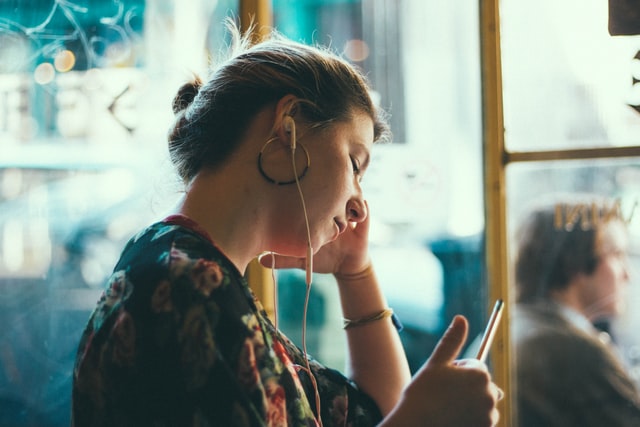
    Woman looks tiredly at her phone with earbuds in her ears.
    So very, very tired. (Photo by Siddharth Bhogra on Unsplash)

    Enter audiobooks.

    If you want to read, but you’re an exhausted parent (or really just a regular exhausted person with a busy schedule), I cannot recommend audiobooks enough. If you read fast, audio might be slightly less efficient for you, yes. But an audiobook diet will keep you from looking up at the end of the year and realizing the only things you successfully read for fun were articles about your kid’s developmental milestones or reviews of movies you’re definitely too tired to watch.

    The main selling point for me is I can listen to an audiobook while I do other chores around the house. All the repetitive, mundane tasks that must be done every day can be enhanced with books.

    I know a lot of people like to listen to music or the news or podcasts while they’re doing these kinds of tasks. And I listen to all those things occasionally too, but I’ve discovered that what nurtures my soul the most is busting through my to read list. (It must be said at this point: yes, listening to audiobooks is reading. Please don’t make me enter this debate.)

    My favorite activities for reading audiobooks:

    1. Washing dishes/washing and filling endless cycles of bottles – My least favorite chore of all time, made tolerable by books. (Pro tip: Use earbuds or the rushing water will drown out the sound.)
    2. Folding and putting away laundry – Words cannot describe how greatly this task is enhanced when you don’t have to think about how much laundry you will be folding and putting away for the next five years of your life.
    3. Driving to the store – Grab twenty minutes of alone time by volunteering to pick up a curbside order and think about something that isn’t how to force your toddler to eat dinner.
    4. Going on a walk/run – I’m one of those weirdos who prefers to run to books instead of music, but it is an amazing motivator to try to work out so you can read at the same time!
    5. Trying to sleep – This one is tricky because you don’t want to actually fall asleep while the book is going. But if your mind is racing or stress is keeping you up, this is one way to crowd out the noise.

    Some books don’t translate amazingly to audio, but many do. A good narrator can make a book. I love people with soothing voices or who somehow transform into the main character for me. Audio also helps teach me how everyone’s names are pronounced, which can be super helpful.

    Now at the end of the day, I don’t have to deal as much with falling asleep in the middle of the same paragraph ten nights in a row. Or experience the dreaded flip side of reading “one more chapter” until it’s past midnight and I curse my very existence.

    The past few years, more than half the books I’ve read each year have been audio. I wouldn’t have been able to fill the gap with print books. Which means I’d be missing out on 50% of my reads! And some of my favorite books from the past few years have been in audio form, which means I could have missed out on some really awesome writing.

    An audiobook fan yourself looking for some reads? I got you!

    Here are some of my favorite listens from the past year:

    • The Invisible Life of Addie LaRue by V.E. Schwab
      • A woman makes a deal with a god to extend her life, but in return, nobody she meets can remember her. I loved this for a whole host of reasons including historical settings, testing the boundaries of a magical curse, pondering the meaning of life, just to name a few.
    • The Vanishing Half by Brit Bennett
      • Two sisters grow up in the town of Mallard, founded by and for Black people with light skin. They cut and run as teens. Later, one sister returns with her daughter and the other sister disappears after working at a job where she passed as white. This book does not have a lot of action, but I loved the deep dives into every single character.
    • Just Mercy by Bryan Stevenson
      • You’ve probably seen this recommended all over the place, but it’s really good and worth checking out! Especially if you want to be more informed about America’s criminal justice system and how people of color are disproportionately affected by it. Thinking about the number of innocent people on death row is terrifying.
    • The Memory Police by Yoko Ogawa
      • The government keeps getting rid of things, like hats, and all the people who live on the island are forced to forget those things. The amount they are forced to forget continues growing to disturbing new levels. This is such a strange little book and if I had been reading it in print, I’m not sure where I would have landed on it. But having the narrator to gently lead me through it really worked for me.
    • Little Fires Everywhere by Celeste Ng
      • A woman and her daughter show up in town and start shaking up the other characters’ comfortable suburban lives. I thought Ng did a masterful job helping you empathize with all the characters in this book. You get to understand where almost everyone is coming from and really understand how complicated they all are. It also explores a lot of tough issues without being preachy about them!

    Let me know if you have any favorite audiobooks yourself! If you want to try audiobooks out but don’t want to subscribe to a paid service, check out your local library. Most have tons of options at this point.

  • Would I date Mr. Darcy?

    Would I date Mr. Darcy?

    I can only ever hope to look this cute and playful while reading Jane Austen. (Photo by Dexter Fernandes on Unsplash)

    He’s tolerable, I suppose, but not handsome enough to tempt me.

    But to be fair to Mr. Darcy, is it really worth it to try to date any of the men in Jane Austen novels? The books are a delight, and I find some of the relationships to be wonderful. But Mr. Darcy as relationship material? I’m not so sure.

    Here’s a brief look at how Jane Austen heroes stack up in my mind and whether they’re worth dating. (Note: This list is not complete. I haven’t read all Austen’s work, so I can’t comment on whoever from Mansfield Park. Sorry?)

    Fitzwilliam Darcy

    Perks:

    • He has a lot of money.
    • He is nice to his sister.
    • He’s a dick, but he’s honest about his dickishness.
    • He has lovely curly brown hair (probably just thinking about Colin Firth now).

    I know, I know. The whole thing about Darcy is that he seems to be an unbearable prick but is actually a decent dude. But he seems like a lot of work. You’d have to really drag his feelings out of him and that seems exhausting. Also, he’s prone to making snide remarks, and so am I. Most of our relationship would probably just be saying really rude things to each other.

    If I were to choose a man from Pride and Prejudice to date, I think I’d lean Mr. Bingley. Super earnest, nice, willing to show affection toward women. Plus, I love it when he tells Darcy “I hate to see you standing about in this stupid manner” and “I wouldn’t be as fastidious as you are for a kingdom.” Yes, Bingley. Give him what for. Downside? The Bingley sisters are unbearable. So maybe not.

    Captain Frederick Wentworth

    Perks:

    • He’s a captain, I guess?
    • Doesn’t hold much of a grudge.
    • Willing to be friendly with you even if there’s an awkward break up.

    There’s a lot to like about Persuasion. It’s a weird little book that grows on me the more I think about it. I like that there’s a heroine a little more advanced in age and so more in line with modern sensibilities. I also like that Anne made a pretty huge error that she regrets. There’s something to be said about second chances and the quiet pensive feel of this novel.

    So what is a Went really worth? More than any of the other jackasses in this book. Yeah, I’d probably date him. Even if his life, his love, and his lady are the sea.

    Henry Tilney

    Perks:

    • His family has a super weird creepy house.
    • He actually reads and will talk books with you.
    • Will back your play and stand up to his dick dad.

    Who has even read Northanger Abbey, seriously. I mean, I’ve read it twice and at the same time, somehow, have never read it. Let’s just agree we have another book full of assholes and at least Henry can be, like, a nice dude. I’d probably date him just so I could try to see a ghost in the family manor, honestly.

    Edward Ferrars

    Perks:

    • Uh.
    • Hmmm.

    I just love Emma Thompson, okay. Don’t think I’d date Ferrars.

    George Knightley

    Perks:

    • He sees the value in being kind to people.
    • He’s willing to humor your weird relatives.
    • He goes on lots of walks.
    • He will, in fact, call you on your bullshit.

    I don’t hate Knightley, but ultimately, I don’t think he’s my jam. All the characters with money in Emma are a little much for my tastes. Also, he’s like 20 years older than Emma or something and I know it was the times or whatever, but comes off a little weird for my tastes. Rein it in, Knightley.

    Emma is a book rife with terrible men for dating. Mr. Elton and Frank Churchill being prime examples of suck. If you gotta go for a guy in this outing, it is definitely Robert Martin. I would 100% date and marry Robert Martin. He is the most dateable man on this list. A hill I will happily die on.

    In Conclusion

    Jane Austen writes a good book. Her characters are sharp and because she keeps an eye toward social commentary, many of them are entertaining but also huge jerks. The leading men in these books can be charming at times and impossible at others. But in the end, you probably wouldn’t want to date a guy who was raised in the 1800s. He’d probably have appalling opinions.

    Except Robert Martin, of course.

  • Why does television keep telling us the same old birth story?

    Why does television keep telling us the same old birth story?

    A sleeping baby with dark hair is wrapped up in a white blanket.
    This adorable baby could have been born so many different ways! (Photo by Garrett Jackson on Unsplash)

    So a character on TV is pregnant

    A character on a show you watch is pregnant. You already know how this ends.

    Her water breaks. Maybe she’s at home or at work or at the store. Maybe it’s the morning or the middle of the night. But her water water breaks suddenly and unexpectedly. She rushes to the hospital. Or, maybe she’s in a new place and wacky circumstances mean that she’ll have to say where she is so a random person has to deliver the baby instead. Regardless, it’s urgent. That baby is coming!

    Her husband or partner is freaking out. Maybe he faints or cries or in some other way indicates he can’t handle it. Or maybe he’s somewhere else and in a mad rush to get to her in time before the baby is born.

    Now it’s time. She’s screaming because giving birth hurts. She probably yells at some people. Maybe screams at her partner that she hates him. But ultimately, it’s not so bad. She pushes for a few minutes and then the baby comes out.

    The hijinks come to an end. She gets handed a three-month-old covered in goo. Everyone is happy and crying. It’s probably the season finale. Depending on how important her character is and what type of show you’re watching, that baby might be vaguely mentioned and mostly forgotten future seasons or it might become a recurring character.

    The end.

    Why the standard birth scene?

    Now, I’m not really here to complain about how this portrayal is unrealistic. Most people are probably aware at this point that the way birth is shown on TV is often not the way it goes in real life. Instead, I’m more concerned with why this became the narrative and why it seems to be the only one that we ever really get.

    I think the most obvious argument in favor of this kind of birth scene is that it’s dramatic. Your water breaking unexpectedly is a great inciting incident! Having to get to the hospital before the baby is born or not being able to make it to the hospital or dad being stuck across town—maximum drama! Giving birth without an epidural makes for lots of screaming and interesting television! (Although I do think there’s a whole side question here about whether one of the reasons we always see this version is because on some level audiences like seeing women in pain.)

    My kingdom for realistic portrayals of postpartum mothers!

    I don’t have much, but I’ll give it all up.

    Yeah, okay, it’s fairly exciting. And everyone loves a good baby. But you gotta make that shit the season finale because nobody wants to see all that immediate after the birth drama of getting stitched up or trying to nurse for the first time or getting your catheter removed once the feeling as returned to your legs after an unplanned C-section. What I wouldn’t give to see a woman sitting on a toilet and using a peri-bottle. My kingdom for realistic portrayals of postpartum mothers!

    I wonder if some of the sameness of birth stories stems from the fact that writers’ rooms used to be pretty much all men (and, you know, lots still are). There’s a lot to explore through pregnancy and birth, ways to deepen characters beyond the standard beats we already get. Maybe writers have been unaware of that? Or, maybe, they just haven’t cared.

    Let’s shake things up

    Maybe it’s just because I freaking love hearing people’s birth stories, but expanding the way births are told on television could give us so much more interesting fare.

    At this point, I’d be remiss to ignore shows that did break the mold with great success. Crazy Ex-Girlfriend featured your standard water breaking, but then Heather was in no rush to get to the hospital, and when she did get there, she had an epidural and calmly worked on crosswords while she waited for labor to progress. Also, if you haven’t watched “The Miracle of Birth” number, do yourself a favor. It’s incredible.

    Superstore had Amy’s labor offer a commentary on how screwed up the American healthcare system is and had Dina getting an unplanned C-section. Refreshing as heck. (Also, a second shout out to Superstore for giving Amy practically no maternity leave and showing another example of how far behind America lags on this stuff.)

    I can’t help think of all the other ways that different kinds of birth could reveal character and create drama. When I went into labor with my first, I had contractions for a full twenty-four hours before I went into active labor. I ran errands and finished an audiobook and paced around my house and around the neighborhood while my husband tried to finish a coding project to graduate the code bootcamp he was in. Think of the fun subversion of someone’s contractions starting and then all the amazing jokes you could pack in while waiting for labor to really kick into gear. I’m thinking of “The One Where No One’s Ready” as a blueprint here–one of the most beloved episodes of Friends!

    Or maybe, like with my second, you’re planning on a straightforward birth and then the baby flips around breech at the last second and you plan for a C-section and then your water breaks and you have to go in for surgery before you planned. I got super emotional when my original plans for giving birth were upturned and the whole experience was really dramatic for my family. Things like that might seem high stakes when it happens to some random person on the internet, but if it happened to a beloved TV character? So much to explore!

    Granted, that would mean that you would have to see characters making birth plans and talking through options and getting a sense of their communities and the quality of their care and the people they talk to about their hopes and fears. Which…good luck with that.

    Life is a rich tapestry

    Those two examples are just scratching the surface. My experiences were a lot different than the ones on TV, but they were still the experiences of a middle class white person with access to healthcare. What about the women who have struggles, who get trapped in the disparities? How are their stories different? This could help highlight a lot about how messed up giving birth in America can be.

    Every birth is different. You get told that a lot when you’re pregnant, but it’s super true. Having a kid born one way doesn’t guarantee the next one will be too. People who give birth have different risk levels, hold different economic statuses, are different races and ethnicities, and are even different genders. All these factors make each experience so personal and individual.

    And I think it’s a shame that the way television tells birth stories means that we think they’re all the same. Life is a rich tapestry. Writers are writing characters with specific interests and backgrounds and personalities. Those could all come into play in unique and surprising ways while they’re giving birth!

    So why don’t they?

    And what are the untold stories we’re missing out on?

  • Those who stop doomscrolling are probably still doomed to repeat it

    Those who stop doomscrolling are probably still doomed to repeat it

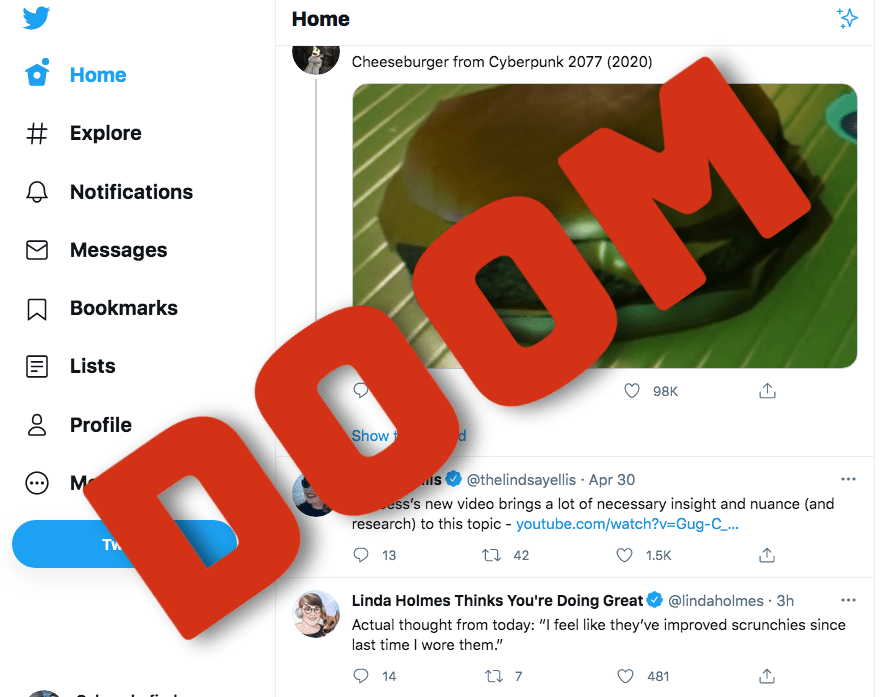
    I just logged in to get this screenshot. I SWEAR. (Thanks to Visual Watermark for the text on image assist.)

    I quit Twitter a couple weeks ago.

    Again.

    My relationship with Twitter has often been unhealthy (a common refrain of Twitter users), but during the pandemic, it really ratcheted up in terms of being a life sucking source. I could not stop doomscrolling. Continually glued to all the absolutely horrendous news about politics, police violence, widespread protests, the fact that California was on fire, just all of it.

    There were times when I thought or said out loud that I needed to stop. Having the internet prove to me every day that the entire world was an absolute dumpster fire was not really the most calming habit I could have picked up during a stressful time. It also made being pregnant real weird. (Even weirder than being pregnant during a pandemic was already.)

    I officially logged out a few times and managed well for a few days or a week at a time. One time I had successfully left Twitter and then Ruth Bader Ginsberg died a month before a national election. When the election itself actually happened, I stayed off all social media for a few days because my anxiety had already reached such a peak I didn’t think I’d be able to survive it. Then, when the votes started suggesting that the results wouldn’t be disastrous, I got back on to celebrate.

    Sometimes there is good stuff on Twitter! Nothing makes me laugh out loud quite like an absolutely bizarre tweet or meme that you only understand when the Twitter brain worms have fully taken over. Because I am officially an Old, and will never download TikTok, I got to see some of the best of TikTok through Twitter. This particular dance to “Rasputin” by Boney M. for example. So delightful!

    The less pleasant aspects of the platform, though, started to outweigh the other stuff. Dunking stupid tweets and dogpiling people seems to be Twitter’s favorite pastime. And although I hardly ever tweet and am too scared to voice opinions to become the Twitter main character of the day, the ghost of that threat seems to loom over all interactions.

    Piling on can be fun in the moment, and it can often reveal truly bizarre intersections of humanity (the most recent examples being Bean Dad and the Cinnamon Toast Shrimp Guy), but it finally started to dawn on my that this meant all my feed was breeding was negativity. Everyone is criticizing everyone. Either because they won’t open a can of beans for their daughter or because people are taking the bean thing way to seriously or because nobody can just have fun on the internet anymore or–

    Even all this might not have been enough to do it. Social media addiction is real and so is starting the doomscroll anytime you have a free second.

    But I had a second kid in December and went back to work in March. I’m up for an hour in the middle of the night most nights. My sleep is pretty destroyed and my days are an absolute blur of taking care of children, trying to productive at work, cramming in a boatload of chores, and then collapsing in an exhausted heap so I can sleep for three hours before the baby wakes me up.

    Most nights, I try to squeeze in a tiny bit of personal time before the exhausted collapsing part. Read a little bit, watch a short show, have an actual conversation with my husband. When Twitter was how I spent my personal time, I got sucked in for far too long, which was then further destroyed my already terrible sleep schedule.

    It all came to a head and I logged out. It’s been two or three weeks now. (I honestly can’t remember just how long because time means nothing these days.) I miss the memes and the goofiness somewhat. But I’m also getting a little more reading in. If I pick up my phone mindlessly, I try to open an ebook or put the phone back down. I can’t marvel at hot takes that truly bend the fabric of the universe, but I can get to bed thirty minutes earlier.

    Mocking Spongebob meme with the text, "I logged of Twitter. What a life hack."
    What I look like talking about how much I’ll achieve now that I’m off social media. (Find image here.)

    Does this make me a better person than anyone still on Twitter? Nope. Social media can be great for people for a whole of reasons.

    Which makes me think. Just because Twitter isn’t good for me right now, could it have been at some point? Despite all the bad on the platform, could the sheer amount of time I spent doomscrolling on Twitter in 2020 have been a little bit good? I was anxious all the time, but that would have been the case anyway. And because I couldn’t see anyone and was essentially trapped in my home, I could at least log on and see that everyone else was feeling the same. We all sort of went a little bit mad together, true, but would it have been any better doing that alone?

    The isolation of the pandemic was pretty heightened for me. Being pregnant is difficult and doing it mostly alone was ever harder. Not that anything I was doing online had to do with the pregnancy. But still. Maybe it was helpful while it needed to be and now I’m entering a new phase where it’s not. Different things for different stages of life and all that.

    Will I stay off Twitter forever? Unlikely. I will be very proud of myself for hitting some milestone in the future. Tell myself that I’ve broken the habit and it can’t hurt to log back on and take a peek for just 30 minutes. Then I’ll discover that someone thinks baking cookies is anti-feminist or that some person we all used to love is actually super problematic or that the shipping wars have fired up over a new media property. And I’ll be right back in it.

    Hopefully, next time, with more really fun dance routines.