Setting goals for yourself can be a double edged sword.
If you’re an Achiever type, who needs to get a set number of things done in a day or you feel like a Failure™, goals motivate you. They are invigorating. When you reach them, you feel so great.
But, if you are this type of person who has to check everything off the list every day and you fall short on a goal, then your feelings of being a Failure™ tend to compound, multiply, and grow until you are convinced that you are the worst and laziest person in the world for not being able to achieve this one thing.
When I started this blog last May, it wasn’t on a whim. I had been thinking about hows and whys of starting a blog for a couple years. For a long time I let my perfectionism stand in the way of getting anything done. I had to come up with the perfect content plan that would include many brilliantly crafted arguments that ended with profound realizations and takeaways.
Yes, I am fully aware I am ridiculous.
Once I gave up on the idea of regularly delivering the impossible through writing and decided that I could do literally anything else, the ideas started flowing. As it turned out, I hadn’t completely run out of ideas and had nothing to say. I’d just paralyzed myself via perfectionism. A lot of my writing for fun in the past has been fiction writing, particularly books. I thought that writing a blog would be a nice, easy release from that. These posts are shorter, therefore they’re easier! (Again, why does my brain do this to me and why do I fall for it every time?)
So I set the goal of a post a week. If you go back through my 2021 archives, I did a decent job. Missed weeks here and there, but overall, considering the having children, being in a pandemic, and the holding down a job then quitting that job and starting a new job thing, I did pretty good.
Then it all sort of unraveled.
This has basically been me for the past two months. Not pictured: The children climbing all over me.
Like many parents, my last couple months have been really hard. Sick children, sick me, daycare closings, the Omicron variant, and a whole mess of other shit has very unfortunately returned me to the type of burnout I was experiencing last summer. (I am not opposed to reviving hot cicada summer for this winter. We can make it work.) But this time instead of trying to power through and do the writing at night, I instead kind of collapsed and started mindlessly watching YouTube instead. Oh, and I also finally saw some Squid Game months after everyone else had already forgotten about it.
The terrible part, other than the absolute grinding burnout, was that I was thinking about writing pretty much every night. But I didn’t have the energy to do it, couldn’t force myself to pull out the laptop. So instead of delighting in this great outlet, I just thought about the article I wanted to write and how much I sucked for not being able to write it. Pretty much every night of December and January. Good times!
My goal for 2022 is still to write and update this blog. Weekly, if I can! But, if not, then often enough so that you know I’m still here. I have a couple topics I definitely want to cover. There’s a whole treatise I want to write about the Kate Winslet/Cameron Diaz masterpiece The Holiday. And although it’s not Christmas anymore, I’m going to write about that silly movie two months after it’s relevant. Because I want to.
I still have a couple thoughts brewing about the Mission:Impossible franchise. I want to write more about how the internet thinks of and approaches content. I want to write more about books. And I have a plea to make to authors and movie makers around the world to please stop giving your mean female characters “mustaches.” What are you doing with that. Stop it.
But the bigger goal, other than posting semi-regularly, is to be kinder to myself. And to remind myself to be kinder than others. It’s been almost two years since this pandemic thing started and everyone needs a lot of grace right now. I basically need boatloads of it by this point.
I hope you’ll give it to me. And I’ll try to return the favor.
The sunlight filters in through the window and highlights your laughter as you eat salad with your friends.
Yes, you have a lunch break. And friends. You are a woman who has it all.
A career that you enjoy. That doesn’t feel precarious (at least not at the moment). You are lucky that your job challenges you and opens new avenues for advancement while at the same time remaining flexible and understanding when family stuff arises.
You’ve never felt the pressure when it comes to having kids. Never felt the squeeze as you debated whether work or staying home with the kids was the best option. Never tallied up the exorbitant cost of daycare and compared to your salary, to your benefits to see which came out on top.
You don’t have to worry that other colleagues are rocketing past you because they are able to put in the time and work that you are not. You don’t wonder if some of your teammates wish you could do more. If they do, that’s their business. What’s it matter to you?
You have a beautiful home with decor that speaks to who you are not what you desperately want to be. (Photo by Paige Cody on Unsplash)
Your children are adorable and a delight to be around. As you had planned while you were pregnant, you stuck to cloth diapering and breastfeeding. You and your partner tackled baby sign language with enthusiasm. You pureed vegetables that you boiled and roasted yourself for the baby and now cook healthy organic meals for your older child. She eats these healthy meals, fully accepting that what you make for dinner is what’s for dinner.
You tackled pumping at work with the first and the second and carried it on for the full year recommended by the World Health Organization. You provide carefully filled and labeled bottles to daycare every day (a daycare you carefully vetted against other area daycares with your selected list of questions that allowed you to weigh a list of options based on what they had to offer and not what they cost. You did not have to make a panicked decision after a ten minute conversation because otherwise the spot would be filled by the next family touring the place).
You wash and sanitize all bottle and pump parts as directed. And replace them after the allotted amount of time. After a day of answering emails and taking meetings while pumping, you measure and label, then scrub and dry the dirty set after washing the dishes for the healthy meal you prepared but before you cycle through a last load of laundry and fold what has just come out of the dryer. None of this makes you feel like screaming until your voice gives out.
You have a partner who supports your decisions and picks up his half of the work. He supports all the work and decisions you make for the children and admires the career path you have chosen, fully bought into whatever you need to do to make it work. You try not to think about the couples where both parents work because they can’t afford not to or the single mothers who have no such support system and have to grind through and find a way to make it work. In order to have it all, you must believe that others can also have it all and that there are not pressures at play that make it impossible for some.
About that loving partner. You make coparenting decisions that you both agree on. You are able to talk through your problems with each other and are so lucky that at the end of each day, you still feel that giddy romantic feeling you did when you first started dating. No crabbing at each other over cold takeout pizza after the kids are in bed before falling exhausted down on a pair of sheets that should have been washed a week ago and barely mustering the energy to touch each other on the hand.
You sleep through the night. You are able to wake up early enough to get something productive done. Each day consists of at least ten minutes of meditation and then finding time to either do yoga and/or go on a run or pursue some other type of cardio. You also manage to fit in a hobby. After all, just because you’re a mother doesn’t mean you’re not still you.
Days are portioned out and unfurl like they are supposed to. You projects and tasks at work don’t get delayed. You don’t forget to bring pump parts with you when a manager decides it’s time to start going into the office again a few days a week. You don’t sit at your desk and worry that someone else you barely know is nurturing your children during the day. You don’t sit at your desk and worry that you enjoy this quiet time away from your children too much and that says something about your suitability to be a mother.
You don’t scroll through social media mindlessly but you do find the time to craft thoughtful posts updating your family and friends about your life. You are able to stay up to date on the latest television shows and definitely know what Ted Lasso and Squid Game are.
You read and listen to interesting podcasts and create playlists to fit your mood and read to your children and buy them STEM games and ensure they can express themselves creatively and also say basic requests in Spanish and find ways to creatively turn even basic tasks into fun games to avoid whining and boredom.
Sometimes, yes, a kid gets sick or you get sick or you suddenly realize everyone is expecting you to host for the holidays this year and the house will really need a deep clean for that to happen and did you ensure the kids will be fully vaccinated by that point and you need to create a menu on top of the other meal planning and preparation you do and how will that layer in to ensure you have work and yoga and cooking and bottle cleaning and cleaning and running and reading and a touch of television and sleeping enough all while ignoring that underlying tension that we are living on a dying planet in a dying democracy and maybe it’s impossible to find any shred of happy when the systems are crumbling around you–
You take a deep breath. Your heart rate slows. All that practiced meditation really comes in handy!
You’re amazing. You’re incredible. You’re a woman who has it all. And the best part is, anyone can do it! We made it, ladies.
As I mentioned in a previous post, I’m kind of on a Mission: Impossible kick. (If you want to read about that journey and determine whether you should get into this franchise, read about some of the best M:I tropes.)
I think I’m personally the egg on the first row, right-most spot. (Photo by Jeff Tumale on Unsplash)
One of the things that I like about this movies, besides it being really fun to watch Tom Cruise run around various cities as fast as he can, is that they’re all kind of different. There’s a lot that connects them as a cohesive group, but I also think each movie puts its own unique spin on the mission at hand. For this reason, despite the fact that they are all definitely action movies, each entry in the franchise gives you a little something different.
If, for some reason, you don’t want to spend your one precious life watching six very silly action movies, I’ll give you a guide. This way, you can decide on the movie that best fits your tastes and your mood. Much like Thomas More, there is a M:I for every season. (I think that joke is a bit of a stretch, but I’m leaving it in.)
The Original Mission: Impossible
Choose this one if: You like action movies that make you think, clever(ish) spy games, a mystery, lower stakes that still feel significant, you want fewer explosions, Tom Cruise looking like a young baby
The first entry into the franchise might be the most distinct. While it certainly still has goofy moments, some ridiculous set pieces, and an absolutely absurd action scene at the end, the original Mission: Impossible is the quietest and slowest moving of all six movies. I was surprised to discover that overall its more of a spy thriller and mystery and less of a big action piece.
If all you remember from this movie is Tom Cruise dangling in a white room, then you might be surprised by the rest of it too.
It’s definitely not a huge think piece. The scene where Ethan Hunt tries to use a 90s search engine to figure out what Job 314 stands for is, frankly, hilarious by modern standards. (The email addresses he concocts and the messages he writes are equally hilarious.) And near the end, I commented aloud that I was surprised by the lack of unrealistic action right before some absolutely absurd shenanigans.
But overall, it’s a pretty good little thriller. In scenes where Ethan Hunt confronts another IMF agent, the camera does these wacky angles to make the conversations more tense and I actually really enjoyed that it tried to put its own visual footprint on things. You know, before Ethan blows up a restaurant with a stick of gum or whatever.
(Oh, also, quick warning that this movie has one of the ickiest lines about women in the entire franchise. More on that in another post.)
Mission: Impossible 2
This picture works because the beginning of M:I:2 features silly rock climbing but also because you will mentally teeter precariously on the edge through the bolder “Huh?” moment of the movie (Photo by Hu Chen on Unsplash)
Choose this one if: You love the theatrical stylings of John Woo, you want to see Prince Henry from Ever After be a bad guy, early 2000s action movies are your thing, you like plots where the threat is a deadly pandemic, you want to turn off your brain completely
This Mission: Impossible is trying so hard to be cool. It’s like when you were a teenager and suddenly discovered what you needed to do and wear to be cool so you tried to do all those things but instead of being cool everyone could tell you were a major dork who was trying too hard.
Just me?
Anyway, this movie is very early 2000s action movie and because John Woo is always going to do his thing, it is also at times hilariously stylized and doves fly around for no reason.
The plot is sadly extremely relevant because the bad guy is trying to make money off a pandemic (he wants to start the pandemic and invests a bunch in the holdings of the pharmaceutical company that has the cure). I love a movie where the real villain is capitalism and greed! Also, Prince Henry from Ever After is cartoonishly villainous and it’s extremely over the top.
This movie also unfortunately invests very heavily in the “here’s a woman who is super awesome at her job but she’s going to become a love interest and do nothing interesting for the rest of the movie.”
I know all of the above makes this probably sound like a fun watch. It can be, but it’s also kind of painful at times and ultimately gets very boring, much like someone witnessing you trying to be cool when you were a teen.
But you do get the theme song exclusively played on an electric guitar, so there’s that.
Mission: Impossible 3
Choose this one if: You like a gritty reboot, you want to see JJ Abrams on full display, you revel in peak Philip Seymour Hoffman, you like someone trying to get out of the game but they keep getting pulled back in, the ultimate goal of the bad guy doesn’t matter to you, good mask shenanigans
I don’t know what it is, but when two sweaty, dirty characters end up in a dirty building and one of them is attempting to bring the other back to life through a form of CPR that is mostly just hitting the other person in the chest really hard, you know you’re watching a JJ Abrams joint.
It’s not that this movie has no jokes, but it definitely turns away from the stylized thriller and the campy action of the first two movies to present you with the real shit. Ethan Hunt only trains agents now, he’s out of the game. He’s in love for real. (Although the amount of time he spends lying to his fiancee in his movie, she should really leave him.)
This movie would benefit, I think, from leaning into its strongest asset: Philip Seymour Hoffman. He chews the scenery with relish and is overall incredible each second he’s on screen, which is not often enough! Also, spoiler alert: the late third act twist that the real villain of the movie is someone else is forgettable. Because who cares about that other guy.
While this movie features more than one woman, one of them dies for Tom Cruise’s character development, one of them is the one he must protect, and the third one can be a spy but only if she’s a sexy spy.
What does the bad guy in this movie ultimately want? I don’t know! It’s mostly just Tom Cruise and Philip Seymour Hoffman being mad at each other! And that’s beautiful.
Choose this one if: You love a romp, good action set pieces, fun spy capers, banter, you don’t need a strong bad guy to center around, increased landmark destruction, limited mask shenanigans, tropes are lampshaded
This might be the most fun of all the movies. And possibly the movie self-aware of the franchise as well. (If it’s not the most self-aware, it’s certainly the one that points out it’s self-awareness out loud the most often.)
I was initially shocked to discover this movie was directed by Brad Bird, who had previously only directed Pixar films. But if you think about it, who better to direct an action romp than the dude who helmed The Incredibles? It especially works because the action in these movies is often goofy and over the top.
Even if you haven’t seen this movie, you might be familiar with the most impressive stunt in it where Tom Cruise climbs the side of the Burj Khalifa, a super tall hotel whose sides are made up entirely of glass windows. It is pretty frickin’ incredible to watch and will make your adrenaline spike at the same time you’re laughing.
This movie probably also features one of my favorite car crashes ever (Tom Cruise purposefully driving off a ramp to go like twenty feet straight down).
Some of the movie doesn’t make much sense. But it’s so entertaining! You will laugh and enjoy. It’s not a chore. It’s just plain fun. The bad guy remains a mystery for a chunk of the movie and when he does finally appear he’s so underwhelming I can’t remember a single thing about him. But who cares? Tom Cruise climbs the Burj Khalifa!
Mission Impossible: Rogue Nation
Choose this one if: You want a straightforward action film
Of all the options, this one most solidly falls into the modern action movie category. I say that sort of rudely because I think this is the movie with the least personality. It’s more watchable than the second movie in the franchise, but it does not have a style. At least you know John Woo is doing John Woo. This movie doesn’t have a stamp on it.
It definitely has its moments. The opening is fun. Some of the technology is ridiculous in a good way (like Simon Pegg’s book computer or whatever the hell that thing is).
But I think ultimately it’s the most forgettable. Maybe if it just had a little more fun. There’s a pretty good moment after Ethan Hunt sort of drowns where he’s trying to do his normal action movie star thing but he can’t. The physical damage makes him slow down. But only for a couple minutes until he’s leaping around on motorcycles again. I thought it would have been much funnier and more memorable if he couldn’t recover, forcing him into increasingly desperate mental gymnastics as Simon Pegg attempts on the physical work.
I do remember that there were two bad guys who looked vaguely the same and I couldn’t tell them apart. Not much else has stuck in my brain!
Mission Impossible: Fallout
Choose this one if: You like when the stakes, action scenes and characters have all been cranked up to 11, you like some brooding and consideration, you like to see an action hero stare down previous actions and face the consequences of those actions
The first half of this movie is pretty good. The second half is nuts.
That’s a compliment.
I watched this one over the course of two nights. At the end of night one, I was a little underwhelmed. There had been some good scenes and moments (the fight scene in the bathroom being one), but I was waiting for something to click. Where were my mask shenanigans? Where was Tom Cruise running as fast he could?
The next night I sat down and the second half delivered hard.
I actually do like that in the first half of the movie, Ethan Hunt is forced to think about some of what he’s done. The brooding was extremely dramatic, but I am a sucker for the late installment of a franchise letting you know that the main character is messed up. It only makes sense that Tom Cruise would be traumatized by some of what’s happened to him! It doesn’t always make for super entertaining storytelling, but damn it if I don’t appreciate the swing.
And, like I said, the sheer amount of over-the-top absolutely ridiculousness of the second half more than makes up for a slow start.
If I have failed to capture your mood or preferences here, let me know, and I’ll happily assign you a Mission: Impossible movie to watch.
The world is full of advice and a lot of that advice is pretty bad.
It turns out that giving good advice is harder than it looks. I think this partially because if you reduce advice to a pretty generic level, it’s bound to be at least somewhat crappy. People are so different and employ such varying tactics to reach success that a piece of advice that’s great for one person is probably fundamentally wrong for someone else.
Some of it is that certain pieces of advice have become so baked into standard interactions that a lot if it is just tired at this point. Or, as many people are discovering, many classic pearls of wisdom are really so ill advised, they will simply cause the recipient to melt into a puddle of anger. (At this point I’m pretty sure if you run into a harried young parent in a grocery store who is about to undergo a nervous breakdown while their child screams nonstop and tell them to “Enjoy this while it lasts,” you deserve to receive at least one colorful swear word thrown back at you.)
I am good at giving myself bad advice. I do it daily. Not only that, I regularly tell myself the same kind of bad advice that for some reason I expect to be good advice today. Almost every morning I wake up telling myself that with a little work and some willpower, I’ll be able to fundamentally change my habits and who I am as a person. (Spoiler alert: It doesn’t work. For more on that, read about what I should know better by now.)
Recently, I was thinking about contributing my services to a silent auction by providing something different than a physical object or a solid deliverable of some kind. I had the thought that I could send someone daily affirmations, weekly compliments, a series of songs and GIFS and videos that were guaranteed to brighten their day. But my favorite concept idea was sending someone deliberately terrible advice.
Not the kind of terrible advice they might think is good advice. Advice that is so obviously bad they would absolutely never take it. For some reason, the idea of telling someone to smash all their computers with a hammer or only eat grapes from here on out really cracked me up. So I decided to do a short write up of some advice I have for you. It is very bad.
In fact, forget lemonade all together. Ponder the eternity of death while you eat a lemon rind. (Photo by Florencia Potter on Unsplash)
When life gives you lemons, juice the lemons, toss the juice, and then eat the dried out pulp and rinds with relish.
We’re all sick of hearing about making lemonade out of our extremely enormous pile of lemons at this point. But have we all tried to feast on the lemons themselves until we can no longer feel our tongues and our mouths are stinging badly from multiple micro cuts we didn’t know we had?
When the baby sleeps, go dream walking with a series of mysterious and fantastical creatures to discover the secrets of the universe. When the baby wakes, go to sleep for real.
Sometimes babies have to understand that you need time to pursue your hobbies and passions and time to properly rest.
Sprained your ankle? Get purposefully bitten by a poisonous spider so the sprain will hurt less in comparison.
Snakes and scorpions are also acceptable alternatives in a pinch.
If you are trying to meet a tight deadline and can’t find the motivation, close your laptop and walk into the woods, never to be heard from again.
Honestly, this is great advice.
If at first you don’t succeed, stubbornly refuse to do that thing ever again and avoid mention of said hobby until your brain literally wipes all memory of it ever existing.
It’ll be pretty awkward when you don’t know that baseball, swimming, or art exist, but that’s a price you have to be willing to pay.
Remember, when it comes to communication more is more. Relentlessly text each member of your family about anything and everything that pops in your head. The more mundane the better.
Every meal, every bowel movement, every moment of idle chatter. If five minutes have passed, it’s been too long.
If anyone asks how you’re doing, just scream wordlessly until you pass out.
Bonus points if you tell them you’re haunted and the ghost inside you hates feelings.
Now that I’ve purposefully tried to generate some bad advice, I think some of it might be good? Definitely the disappearing into the woods thing. You should definitely drop everything you’ve got and just go disappear into the woods. (Disclaimer: Don’t do this.)
I have amused myself. Now it’s your turn. Go on, hit me with your best bad advice!
For a reason I can’t quite explain to myself, I recently watched all six Mission: Impossible movies.
The embodiment of a popcorn flick. I snacked so much while I watched these movies. (Photo by GR Stocks on Unsplash)
I don’t have a long and storied history with these movies. I hadn’t even seen them all before. I don’t have strong feelings about Tom Cruise. Action isn’t particularly my genre. It’s just that one night I watched Ghost Protocol (the fourth movie of the M:I oeuvre one for the uninitiated) because it was on Hulu. And when it was over I thought, What if I just watched all these movies?
So that’s what I did.
As it turns out, I am in extreme danger of becoming mildly obsessed with the Mission: Impossible franchise. Not because I thought the films themselves were so amazing but because…I don’t know. Because 2020 and 2021 were hard and my brain has permanently rewired itself in some really weird ways?
For anyone who finds these movies enjoyable, I actually would recommend watching them all right around the same time. My method was watching one a week (sometimes splitting one movie up over the course of two nights). So it took me about six weeks to finish them all. Really just about the perfect timeframe for digestion.
I think that this watching method made my experience with Fallout (the latest movie, released in 2018) more enjoyable because I was already on the lookout for all the tropes. When certain things happened, I laughed way more than I should have. Just because all the other movies came to mind so vividly.
Because this is a personal blog and I can do whatever the heck I want, I’m basically planning a series of content about Mission: Impossible (I told you, I might have a problem). It seemed a waste to dedicate 12+ hours of my life to watching these movies only to boil it down into a basic ranking, so I won’t be doing that. (Also, not convinced I have a favorite. They’re a team effort, really.)
Instead, I want to write an article about how each movie is kind of its own genre while still fitting within the same action scope. Each movie really does have its own personalized take on the same stuff, which I found progressively more fascinating at the franchise progressed. I want to cover some of the best and worst moments by thinking about best stunts, best heists, worst use of Ving Rhames, etc.
There definitely needs to be a discussion on how women are used in these movies for sure. (Spoiler alert: They are generally not used well.)
Will I own this DVD one day? No, seems unlikely. But in my heart? Yes. (Courtesy of Paramount Pictures.)
And then I’ll see what else shakes out in the process. Will I do a full six article series to coincide with each film? Not on purpose. Will I watch the new one when it’s released? Oh yes. Unfortunately, I think I’m now a Mission: Impossible person. (The only thing more confusing than that is why the abbreviation for the second movie is M:i-2. Why the lowercase “i”? Why mix your punctuation in such a way? Who approved this!?)
For anyone unfamiliar with the movies or anyone who is only familiar with some of the more famous moments (okay, the famous moment where Tom Cruise* is hanging from a string in a white room), I thought I’d start with a little primer. Some common Mission: Impossible tropes. If you find these things vaguely charming and you like action movies, you might want to try them! On the flip side, if you find these things obnoxious, it’s best to steer clear.
List o’ tropes:
Masters of disguise – These movies are full of disguises. And masks! I love a mask scene every time in happens and am more delighted the more ridiculous the reveal is. Anyone could be anyone! Did you check to see if they’re wearing a mask?
Tom Cruise running a lot – I think it’s fairly common knowledge at this point that Tom Cruise loves to do his own stunts. He also likes to run fast on camera, I guess. He does it in every movie. And he has a very specific gait. My husband and I laughed every time he did it.
The big twist – These are big, dumb action movies, but they’re also spy thrillers. So there’s always a twist about the bad guy or what happened or who did what. By the end of the series I got really good at predicting these right before they happened.
Random big name actors you want to be on screen more – Anthony Hopkins is in M:i-2. Huh? Laurence Fishburne is in M:i:3. Excuse me? Tom Wilkinson is uncredited in Ghost Protocol. Keri motherfrickin’ Russell is in Rogue Nation and Angela Bassett is in Fallout! Why does Angela Bassett have less screen time than Superman! It doesn’t make sense!
Funny stunts – Some of the stunts in these movies are very cool. Some of them are eh. Some of them are really funny. Whether because they’re over the top or purposefully comedic. One of my favorites is Tom Cruise driving a car off a ledge in a parking garage to crash it like twenty feet below. Or getting sucked in a plane when the door opens. Or nearly getting a helicopter blade to the throat. Or being in a car that rolls like eight times. My God. These movies are funny.
The impossible mission moment – There’s always the overarching “your mission, if you choose to accept it” for the movie. The impossible mission moment goes beyond that. There’s some kind of information the team needs and to get it they have to break into a facility with extremely advanced security measures. This ends with Tom Cruise dangling from a string in a white room or holding his breath underwater for three minutes or setting up a screen the projects the hallway behind him so the security guard doesn’t notice as he pushes it closer to the desk.
Tom Cruise struggling to move after getting the absolute crap kicked out of him – There’s a moment in every movie where Tom Cruise has done something reckless and has been completely physically wrecked by it. And then he really painfully and agonizingly tries to move around afterward. It’s great.
The theme song – Obviously. I’ve had it stuck in my head for weeks. Some of the movies in the franchise use it better than others (shoutout to M:i-2 for the worst but funniest version), but it’s always there. And you can never stop it.
There you go! Interested but don’t want to watch them all? I’ll put out a list at some point in the nearish future that breaks down the general overall feel of each movie so you can pick your poison. Cerebral spy thriller, stupid early 2000s action nonsense, gritty reboot, light spy romp, the brooding one? Don’t worry, there’s a flavor that’s right for you.
Check back in for non Mission: Impossible related content at some point in the future. I’ll get there.
*I should mention that the character’s name is Ethan Hunt and everyone else in the movies will remind you of this by saying his name approximately 10,000 times each movie. But one of the aspects of the movies that’s so fun is they’re also about Tom Cruise playing spy. So we’re sticking with the name of the real guy.
It’s Banned Books Week! Or, maybe you’re reading this at some point in the future and it’s no longer Banned Books Week. Easy solution: Live your life like every week is Banned Books Week.
In the past, I have often celebrated this auspicious occasion by reading a banned book. When I used to do a book podcast (um, I used to host book podcast called Novel Ideas, if you want to listen to some old book takes), my brother and I would go look up recently challenged books and read them.
On the one hand, if you take this approach, you get to read a lot of great books! On the other hand, it’s depressing and predictable what’s going to make the list. If a book has LGBTQ+ content it’s like a million times more likely to be on the list. Also, books that deal with important but dark subjects get put on there a lot because the content is so shocking and terrible! But the point is to talk about a difficult subject? And how can we talk about difficult subjects without talking about them?
It probably goes without saying, but I am not a fan of banning books or trying to dictate what anyone reads. When I was a kid, my mom let me read pretty much anything, even if it was out of my age range or above my reading level. (This is how I read The Fellowship of the Ring in the fifth grade and didn’t understand it at all and then read Dracula in the seventh grade and what the hell. My mom truly let me read whatever.) I got to experience some really cool books this way! I also read some stuff that went way over my head and I didn’t realize just how much until I read the books again at an appropriate age.
I was going to make a joke about someone knocking that stack over, but I don’t think anyone will ever want to read any of those books. (Photo by Ying Ge on Unsplash)
I’d also like to say that this isn’t the sort of position where I don’t like it when certain books are banned but am okay with it in other contexts. I do not approve even when stupid books I don’t like are challenged. Reading a stupid book I don’t like has often made me annoyed, but I think there’s value in reading them nonetheless. Reading opens you up to new worlds and perspectives and helps you learn more about what you like and what you think. And if that book challenges your set worldview? Good.
Reading dumb stuff you don’t like sometimes can help you clarify your thinking more. Maybe it helps you better articulate why you don’t like certain things, maybe it helps you think more critically about why you don’t like certain things. Whatever the result, the process is good and it helps you grow.
What’s not great is looking at list of what a book contains and claiming that it’s going to corrupt young minds. That shit is tired. Scandalized by sex? The internet and television both exist and both of those things contain sex, so it’s not like teens will never hear be exposed to sex unless they read Lady Chatterly’s Lover or something. Violence is all over television too. The American Library Association points out that some of the most frequently challenged books contain diverse content. I mean…gay people exist and so do Black people and banning a book won’t change that.
Also, can we please stop trying to ban books that teach children about their bodies and where babies come from? They need to get the information from somewhere and a reliable book with good information is much better than a parent stammering through a half-assed explanation. We all have bodies! It’s okay to learn about them.
Reading new books will challenge you, will teach you to think about different people and points of view, will introduce you to new ideas, will generally make you more empathetic, more open, and more willing to embrace nuance.
I’m incredibly biased because I love to read, but even if you think the above is a little too rosy, you have to admit that a good book can make you have a lot of feelings and a lot of thoughts and that’s a good thing.
With all that said, I encourage you to read some banned books! Maybe some that have been challenged recently or are frequent targets. Maybe something like…
Speak by Laurie Halse Anderson
I had to include this because Speak was one of the most challenged books in 2020 and the thought that a whole swathe of people saw a book that is literally about a young girl trying to find the courage to speak out and then decided they wanted to silence it is really just a whole level of irony I wasn’t prepared for.
The book does deal with sexual assault, so take that into account. But I remember when I first read this book in high school, it blew my entire mind. It takes the issue really seriously and shows the long-lasting effects of assault and how people’s responses to it often continue to harm victims.
Apparently one of the reasons it was challenged was because “it was claimed to be biased against male students.” Umm, only those who commit sexual assault. Which, is probably an okay reason to be biased against someone. Maybe read the book next time?
And Tango Makes Three by Justin Richardson and Peter Parnell
This is a cute picture book features two male penguins at a zoo who adopt an egg and when the baby penguin hatches, they have a little family. The story is based around two real life penguins who did something similar.
The fact that an adorable children’s book about gay penguins nurturing an egg and subsequently a baby penguin is the sixth most challenged book of the past decade really tells you something about society. Not sure what, exactly, but something.
Read this one to your children out of spite and then feel a little warming in your heart.
Fun Home: A Family Tragicomic by Alison Bechdel
A graphic novel and a memoir, this book is a really interesting look into Bechdel’s family and her relationship with her father. It includes a couple surprising revelations about her dad and her own journey to discovering who she is.
In case you haven’t guessed it already, the book is not called Fun Home because Bechdel grew up in a really fun home. But certainly one rife with secrets and frustrated desires.
The Hate U Give by Angie Thomas
Timely for a whole host of reasons and I’m sure it’s challenged for the exact reasons it’s relevant. I liked this book and thought it did a good job tackling a tough topic and making it relatable. The book is definitely YA and features some of those common YA tropes, but I didn’t mind that so much because of who the intended audience is. It’s a good entry point for adults too, though.
This book also recently was made into a movie, which I didn’t see, so I can’t vouch for its quality. But the book is definitely worth checking out.
Beloved by Toni Morrison
This book is wild and dark. It has lots of metaphorical hauntings and one haunting that seems to be pretty literal. At times this one takes turns that will leave you scratching your head, but ultimately it faces the brutal history of our nation and grapples with how the past can cause ongoing trauma that people carry with them for a long time.
Quick aside: I recommend reading Toni Morrison in general, but if you are an audiobook person, try to find one that she has narrated! Her voice is lovely and soothing and listening to her read her own work made a lot of the writing style come alive for me in a way it didn’t when my own clunky brain was trying to process it.
Awakening by Kate Chopin
In my junior year of high school we had the option of reading a couple different books, and I specifically chose Awakening because it had created such a scandal when it was first published for featuring a woman who cheated on her husband. Spoiler alert: This book is not lurid and contains no sex. It’s all implied and vaguely talked around. Seventeen-year-old me was extremely put out by this fact.
Reading the book again years later, I was less annoyed by the lack of sex. Instead, I was struck by the fact that the main character had complicated feelings about her children, and I thought that was really cool. She’s allowed to be unhappy in her marriage, not because her husband is a terrible, abusive human being, but just because she doesn’t like him very much. And she’s allowed to be ambivalent about being a mother. Those are not things you get to see very often!
Spoiler alert: She is not allowed a happy ending and gets punished for her transgressions. Thank goodness they don’t make us all walk into the sea when our children give us complicated feelings.
This list is definitely not exhaustive. I’ve read other books on the banned and challenged lists and enjoyed them! I’ve read some books on those lists and not liked them much at all. Consider checking out these 100 most challenged books from the last decade. Give one a try. Or if you’re just looking for some books from different perspectives, you can see some of my recommendations for Juneteenth and Pride Month.
It’s okay if you don’t like one. Or if you don’t want to read a certain entry. We can all choose what we want to read. And it’s okay if those things are different than what other people want to read.
I’ve experienced this thing several times in my life and I’m curious to know if it’s familiar to anyone.
When I don’t know much about a subject, I’ll have a general opinion about it. Then, the more I learn about that subject, I’ll learn nuances I didn’t know before and my opinion will take a sharp left turn. Then, as I learn even more, I mellow out and veer back in the direction of my original take.
She is judging the shit out of your movie. (Photo: Painting of a woman from the Rijksmuseum in the Netherlands. Public domain.)
For example, historical accuracy in works of fiction. I’ve always loved and been interested in history and liked watching period dramas, but in my younger days I didn’t think about it too deeply. If I heard something wasn’t accurate, I might briefly pause to think, “Huh” and then go about my day.
Then, as I started taking more serious history classes and seeing movies and TV depicting topics I knew stuff about, the issue of accuracy suddenly became much more important to me. I felt superior for knowing when things were inaccurate. I liked nit picking all the bits and pieces and reading more into the actual history.
While I still like reading into the actual history, I don’t care as much about all the details of a story being fully accurate anymore. Stories are stories for a reason and sometimes you have to fictionalize stuff. There are a lot of reasons to introduce inaccuracies into your narratives and many of them are fine.
It’s fine. Really, it’s mostly fine.
Let’s explore.
Real life doesn’t follow a neat narrative arc
One of the big real historical reasons people and events get messed with in books and movies is that they have to get messed with to make the story work.
If you’re writing a story, you typically want it to be compelling. That means character growth and an ending following a narrative climax and a timeline that makes sense for a limited runtime or number of written pages.
Two battles actually took place ten years apart or a piece of legislation was actually signed three years after the fact or the king had five close advisors instead of two?
Well, you try cramming in a time skip that makes sense or fully developing five dudes named Thomas so the audience doesn’t get confused and then report back.
Simplifying a story is often the choice that makes narrative sense. It may be sad for the weird nerds who have studied the primary documents, but there are only so many of us in the world.
Changes that are made to help make the story work are fine with me. Unless those changes are made to make the story rote and stale, then I take issue. (More on that below.)
There needs to be a connection for the audience
History is a really fascinating and tricky subject. Learning about how people used to think and behave can shock you, either because people back then are so similar to the way people are today or some of the things people used to think are so different than the way we think now. It’s kind of a weird contrast because sometimes people will do things you totally recognize (drawing graffiti dicks on things) and then do something baffling (shun someone for a seemingly innocuous religious belief).
Because of this, sometimes the story has to fudge history a little to help the audience relate the characters. It’s why you end up with a lot of historical fiction featuring women who want to make love matches and be the equal of their husbands and then start spouting some pretty suspiciously feminist stuff.
Sometimes, also, historical stories can serve as interesting metaphors and comparisons to modern life (science fiction is the genre most notorious for critiquing the present while talking about a different time, but it doesn’t own the concept!).
Marie Antoinette is a great example of this. A lot of the costumes and events are pretty historically accurate but the important thing about this film is not exactly what happens in it. Who cares if all the actors are speaking in their regular voices and not doing accents? Who cares if there’s a modern soundtrack? Sofia Coppola is helping the audience connect by showing how Marie Antoinette and her buddies acted in a way that’s not entirely different from entitled young people in the modern day. And it’s an approach that I think works overall.
We don’t really know exactly how stuff was anyway
We know written language (sometimes) and art (sometimes) and customs (at least some of them). We have access to the artifacts that have existed to today. But not everything made it. And when you can’t interact with the people in their own setting, you can’t know exactly how everything worked.
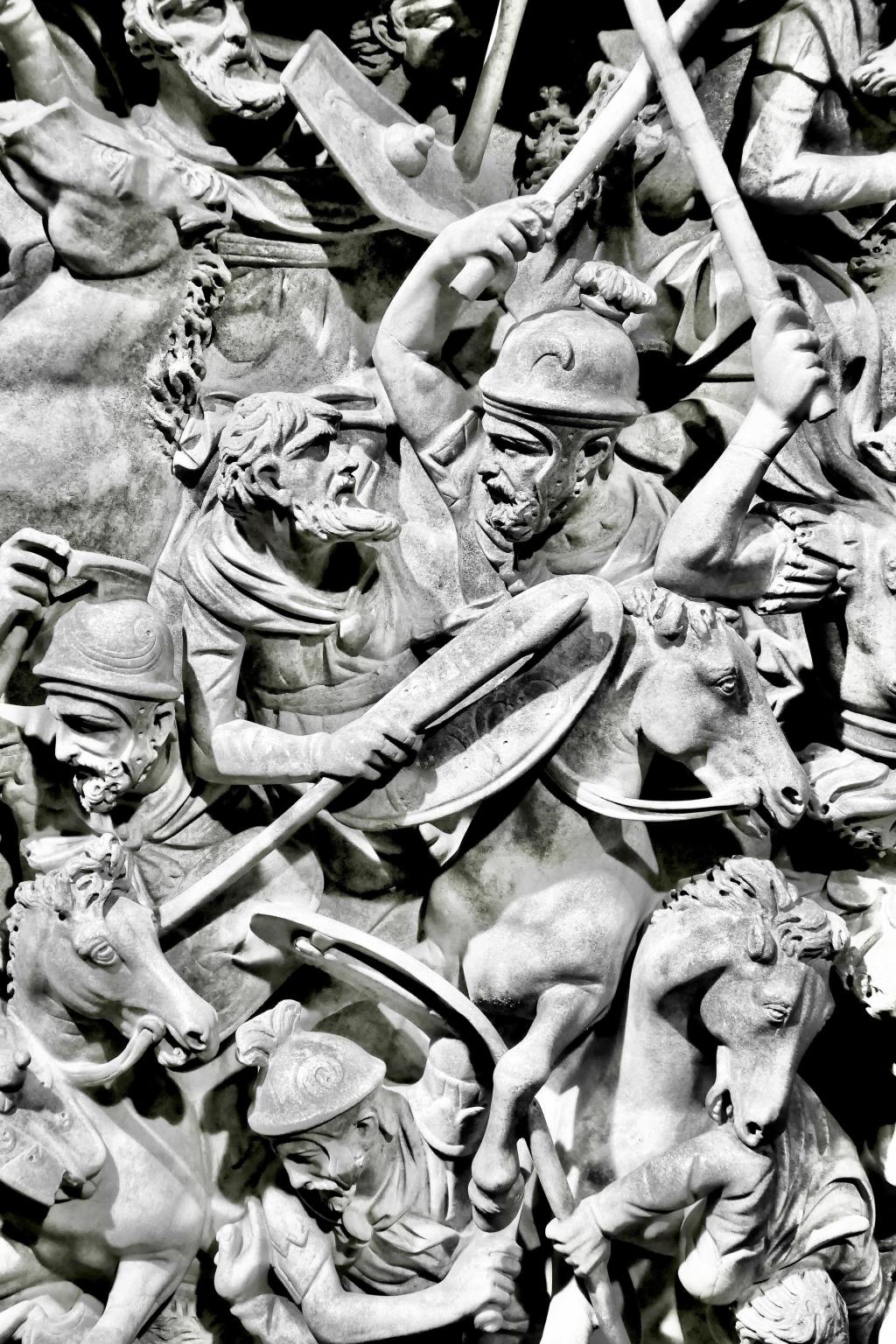
“What’s up?” “Oh, you know, just wondering if this battle could have been carved more accurately.” “Cool. I’m gonna stab you now.” “Dang.” (Photo by Massimo Virgilio on Unsplash)
We have our best guesses, but we don’t know everything. Drop a historian back into the time they’ve studied for years, and they’ll immediately find things they had thought about incorrectly. (This is one of the things I love about Doomsday Book by Connie Willis. How much the historians get wrong.)
Think about all those beautiful marble statues from ancient Greece and Rome. When we watch movies and TV shows, these statues are all pristine white, just like they are today. But it’s been discovered that these statues were actually covered in layers of paint and it’s just been such a long time that most of that paint has chipped away. Are you going to watch a movie set in ancient Rome with painted statues any time soon? Probably not. People still generally think of the white statues when they think about the time. It’d probably cause too much confusion for the audience. So it’s inaccurate. Does that make it wrong?
Keep in mind too that it’s impossible to eliminate bias. That applies to the people who wrote about historical events contemporaneously and the historians who came along afterward and interpreted those events and primary sources.
All that said, I would like to say that there are still some things that stick in my craw. I’m not willing to blanket forgive all inaccuracies.
Following tired tropes doesn’t make a better narrative
Sometimes stories are changed to make more narrative sense. Sometimes they are changed to fit into a set formula. This I do not like. People are messy and complicated and putting them into a paint by numbers script doesn’t do anyone any favors.
Biopics are horrible about this. Fitting a person’s entire life or entire career into a two hour movie is really difficult without completely flattening the person out. Why do we feel the need to this? Why can’t we show certain moments or key events and then lean into the weirdness and individuality that makes people who they are?
These kinds of changes are especially egregious when the person being covered was an outside the box thinker or actor but the movie about them is being forced into a narratively traditional box. I’m thinking of movies like Bohemian Rhapsody that do the real person a huge disservice. (Also The Imitation Game. Why did I have to watch movies about queer men that only showcased them having romantic relationships with women.)
I get making changes to fit a smart and compelling narrative. I don’t get making an interesting person’s interesting life boring and formulaic. That sucks.
Sometimes the real history is more interesting than the fiction
When looking up the history behind a movie before, I’ve discovered sometimes that what actually happened was far more interesting that whatever the movie did. And sometimes I have to wonder why the more interesting, real event wasn’t included.
One of my go to examples for this is Gladiator. Commodus was a bit of a wild card emperor who allegedly dressed up as a gladiator and fought in the games. I overall think his character is done well in the movie and that Joaquin Phoenix is probably the best part of the film.
And I guess dying in the arena sort of fits with the real guy and it makes sense for the movie. But in real life? Commodus was strangled in a bathtub by his wrestling partner Narcissus. And this was after an initial failed assassination attempt to poison him.
Uh, what! That’s wild. Work that into the movie, dude!
In addition, I think it’s worth pointing out who gets their story told at all. There are so many incredible interesting historical figures out there who have never had a movie made about them because they are the sort of people that tend to get overlooked. Instead of another biopic about a white guy who did a thing, could we get more movies about awesome bisexual sword fighting nuns/opera singers? (Julie d’Aubigny ruled. Make a movie about her!)
Ultimately, is it an entertainer’s job to present historical people’s lives and historical events accurately?
I’m not convinced. While a show or movie might be someone’s only reference point to history and it can certainly warp their view of the past, popular media can also serve as jumping off points for people to dig into these subjects more.
I’m less concerned about whether a dress has the right flounces or a battle takes place the right year than I am about producers falsifying stories to the point where they can become directly harmful. (Big side eye to every story that whitewashes real people or pretends people of color didn’t exist several hundred years ago.)
In a lot of cases, inaccuracies can be annoying for someone who knows a lot about the subject, but I guess you just kind of have to get over it. Nit picking something to do death is not really the most helpful form of critique.
To crib a quote from our buddy Maximus, it’s more important whether you’ve been entertained.
Don’t worry about it so much!
Unless it’s a Mel Gibson movie. Drag him through the mud.
Recently, I had the delightful experience of being on the podcast What People Do with the ever wonderful Brendan Howard (listen to my episode!). We talked about writing and all the different forms of it and some of the questions he asked me got me thinking…why do I write, exactly?
Aside from the fact that I’ve committed myself to a blog and if I don’t pound something out on a semi-regular basis, I am filled with a deep sense of shame.
It’s hard to pinpoint. I don’t know that there are concrete reasons. It essentially boils down to: I like doing it, I think I’m pretty good at it, and it’s really satisfying to get something down.
But it’s not like I have to write. I’ve gone through long stretches where I haven’t written much, if at all, and it didn’t make my life way worse. It definitely left a small hole and made me question my identity as a writer a bit, but I didn’t have a full out crisis.
If I suddenly decided to stop writing forever, I don’t think it’d hurt anyone. There isn’t a crowd out there clamoring for me to produce content. (At least, I don’t think so. Are you clamoring for me to produce content?)
But there’s got to be something. I mean, I keep doing it. And often simply for personal fulfillment. I amuse myself with my stupid jokes and that’s usually enough for me.
Still, I think it’s a useful exercise to try to pinpoints the whys behind my need to be creative. So here’s an attempt at that.
I love to read
This is sort of a basic observation, but most authors are avid readers. I have only ever met one aspiring writer who told me they didn’t read, and when he told me that I immediately gave him reading assignments. (For context, I was tutoring him and he asked for advice on how to be a better writer. I won’t randomly assault you in the street if you don’t read.)
For one, reading helps you figure out what other writers do that you really dig. It helps you figure out writing tactics you don’t like. It helps you become versed in tropes, which teaches you the appropriate times to break or upend those tropes or really lean into them. Reading is incredible for a lot of reasons, and I wholeheartedly embrace the advice that if you want to get better at writing, you should probably read more.
Also, it makes sense to me that if you love to read, then you would want to craft some kind of written text that other people will love to read. Readers love to share with other readers.
I like making other people happy
I don’t know if love languages are a bad thing to reference, so sorry if they are, but I’ll be damned if my love language isn’t acts of service. When people are in a bad way, my mind immediately goes to what I can do for them. What can I give or provide that will make them feel better? Usually the answer to that question is baking them cookies. But in my younger days, I used to write friends short stories for their birthdays and other holidays (they would give me a prompt and away I went.)
Last year, right when lockdown was looming imminently, I started a newsletter where I sent out a chapter of the book I was writing every day. This was partially to force me to stay on top of my writing, but it also came from a place of trying to give people something comforting to expect in their inbox each day.
When someone does read what I write and report back that they loved it or it made them happy, I’m so glad that it touched them in some way. You give me feedback that you like my writing, and I’ll go out of my way to make more writing happen for you.
Here’s a metaphorical image about following your path. (Photo by Matthew Waring on Unsplash)
It gives me a sense of purpose
Life is wild and the world is a mess. I’m constantly running around trying to get everything done and falling shorter than I’d like. Not to mention that I have yet to land that mythical job that magically fulfills everything I need in life. (Spoiler alert: These jobs don’t exist. Even the really good ones.)
Writing gives me a purpose. I might not be changing the world, but this is something I can do for myself. It’s a way I can make something that I think matters. I value words more highly than just about anything. So writing helps me practice what I value, and it gives me something meaningful to do. And to tell others that I do something meaningful.
I’m becoming a skilled expert
If you have read more than one article on my blog, you already know that I struggle with perfectionism. But also, strangely enough, writing has never been something I’ve felt the need to be immediately perfect at. I wrote prolifically throughout middle school and it is all absolute drivel that just rips off other stuff I liked. But that never stopped me or disheartened me. I loved doing it!
I’m now good enough that reading stuff I’ve recently written usually doesn’t (usually) make me cringe, and it’s nice to know that the more I do it, the better I get. That I’ve effectively “honed my craft” for enough years that I’m something of an expert. That I could, maybe…teach other people lessons I’ve learned? I have been paid professionally to write. Like, on some level, I’m a professional writer.
That’s kind of weird, but it’s also cool. At least I’m good at one of my hobbies, by god! (My other hobby being running, which I am terrible at.)
It’s fun to see the fruits of your labor
Finishing a project just feels good. Posting an article, finishing a book, capping off that play. It’s amazing to be done and then to go back and read what you’ve written. You have proof that you did a thing! That is so cool. When I go on a long run, I’m sore, but I have no physical document that shows that effort I made.
This is a great side benefit. And sometimes when I go back and read something I wrote awhile ago, when some of the details have gotten fuzzy, I’ll come across a clever line that actually makes me laugh out loud. It might be super embarrassing to admit that I can make myself laugh out loud with my writing, but I think that’s kind of neat!
I don’t know that I’ve really dug all the way down to the heart of why I do this writing thing, but I think these are all pretty good reasons for why I keep doing it. Why I keep setting myself goals and starting books that nobody but me might ever read.
Really, if nothing else, I hope you take away that it’s good to pursue things you like to do that make you feel good. And it’s okay if those things don’t make you money. It’s okay if you just do something because you like it and you want to do it. Don’t let weird productivity/hustle culture steal your joy.
And if you feel so inclined, let me know what you love to do. I bet you’re great at it.
In the interest of continuing to produce content that adds to ever growing content pile that is the internet, here’s a new post! (Read my thoughts on the noisy world of content we live in if that’s your sort of thing.)
One of my goals for this blog is to write thoughtful or thoughtful-ish pieces that fully explore something I’ve recently read or watched or listened to (like this semi-recommendation of The Count of Monte Cristo).
But like anyone who has ever had to write an essay knows, having to start something thoughtful can be super daunting even if the actual practice of writing it isn’t that hard.
So, in the interest of making things easier for myself, I thought I’d give a couple mini-recs based on what I’ve consumed this month. Short and I don’t even have to remember that far back! Double win.
For your consideration…
YouTube: Great Art Explained
Also, check out the Arnolfini Portrait episode! So good!
I love a lot of channels on YouTube that feature smart people doing good research and talking about stuff at length. But the “at length” part can sometimes present a problem when I want to watch something less than half an hour long.
EnterGreat Art Explained. I just discovered this channel a few weeks ago, and I love it. Not only because I’ve been learning the context behind famous paintings but because the creator holds himself to 15 minutes or less. Unlike a lot of other great channels where the video lengths creep ever upward, these are stuck at a length of 15 minutes(ish). Perfect!
Really all the videos I’ve watched so far are winners, but I really recommend the one on Judith Beheading Holofernes painted by Artemisia Gentileschi. You get historical context and actual art analysis all wrapped up in one. Good stuff.
Podcast: Maintenance Phase
Dr. Oz has a bad show, you guys!
Co-hosted by Aubrey Gordon and Michael Hobbes, this podcast focuses on “Debunking the junk science behind health fads, wellness scams and nonsensical nutrition advice.” It is a delight!
The hosts have so much fun together and really provide an invaluable service by diving into things you take for granted or don’t think about. Their early August episode on the BMI blew my mind.
Plus they are funny and usually keep it to about an hour so it’s just a good listen all around.
Newsletter: Butt News
I mean, you should be sold based on the logo alone.
I subscribe to several amazing newsletters that I will probably eventually try to force everyone to read, but the one that has brought me the most joy in August is Lindy West’s Butt News.
I’ve been a Lindy West fan for awhile and am so delighted I can read her writing regularly again.
Her movie recaps are hilarious and my favorite end cap of the past few weeks. (Bonus: if you read a few of those recaps and like them, then you should buy her book Shit Actually, which is full of movie reviews/recaps and caused me to laugh out loud multiple times.)
Don’t you want someone trying to figure out why the hell the characters in the first Fast and Furious movie are so obsessed with tuna making their way into your inbox every week? Yes, you do.
TV Show: Virgin River
Come for the ridiculous human drama, stay for the gorgeous shots of the the Pacific Northwest.
Virgin River is just a gentle, warm blanket you can wrap around yourself. In this Netflix show, a big city nurse moves to a small town in the Pacific Northwest following the tragic death of her husband and the curmudgeonly doctor who lives there doesn’t want her help.
Also, the local bar owner is ruggedly handsome and they have good chemistry. What might happen there? (You know what might happen there.)
This show hits the beats I expect in the best way. It’s full of drama, much of which could be solved by people communicating better, some medical drama and cases, and multiple romantic threads. It’s just a good time. And sometimes the characters have inexplicably dress up like lumberjacks or line dance or whatever.
That’s what I’ve got for you this month! For what it’s worth, I almost included Ever After, but I love that movie enough to write a long article about it. You know, one of these days.
A flip switched at some point in the last ten(ish) years and now the world is full of content. Bursting with content. All companies are trying to create content. There approximately five dozen streaming services crammed to the brim with content. Videos and newsletters and podcasts that you love and enjoy that used to be made and written by people are now made by “content creators.”
Everywhere you turn, content is fighting for your attention. Do a simple Google search and you’ll find dozens of pieces of content in multiple formats all fighting to tell you about it. Pretty much anything you can think of probably has some sort of content created about it in some format it.
It’s sort of exhuasting.
Partially because there’s just so damn much of it and you’ll never be able to consume it all.
But partially because most of the content that surrounds you is just noise.
“If we put three people on one laptop, we can produce three times the content!” (Anyone else get an uneasy pandemic feeling about these people sitting so close to each other? Photo by John Schnobrich on Unsplash)
The early days
A quick internet search tells me that Bill Gates is the one who first wrote the cursed phrase, “Content is king.” I have no idea if this true. Probably someone else wrote it first but Bill was the first one to publish it in a forum where enough eyes landed on it to give him the credit.
Classic billionaire stuff right there.
Companies creating actually valuable content used to be a novel idea. The old way of marketing is creating cool ads that capture people’s attention (I guess still a modern way of marketing too).
Advertorials have existed for a long time, but I don’t remember sponsored content from my childhood ever being worth reading. Unless you really wanted to buy a fancy watch and needed 500 words to back you up, I guess.
The internet really shook things up. As search engines got smarter and started finding actual useful articles, savvy marketers learned that writing content with the right keywords got them in front of eyes. I haven’t been around since the early days, I’ve only read snippets of other people’s experience, but my understand is that back in the day, creating content was enough. So few people were doing it that by virtue of doing it, and following a couple of the rules, you got eyes on what you created.
And it worked!
Thus, content marketing was born? I don’t actually know. I’m making it up a little. If not born in that moment, then certainly popularized or recognized as valuable on a more widespread scale.
Drowning in meaningless words
Once people realized they could make content and gain traction with it, they started doing that. Remember the heyday of blogs? Remember LiveJournal?
Companies also jumped on the content train, bursting forth with anything and everything to cash in on those sweet, sweet clicks.
A lot of places skip an important consideration, though. For your content to actually do something, it has to provide value to your audience.
If you write about thing xyz because your competitor wrote about xyz and it get tons of clicks and pageviews, then great! You won! Right?
Not necessarily. You can generate a lot of traffic on an article from people would never buy your goods or services. Just because someone else wrote about it and got lots of views, doesn’t mean you automatically need those views. A lot of businesses see they have a lot of pageviews and call it a day. Successful content!
But you have to consider if those views are valuable. If those people are going and looking at your other stuff, if they’re subscribing or if they’re buying your stuff.
If they read that one thing and then leave never to come back?
Not successful content. Just noise.
Another pitfall is the company that wants to create something valuable that looks great and has good information. They create a beautifully crafted white paper with design and proofreading and everything!
Then nobody downloads it.
Just because something is done well and looks good doesn’t mean it’s valuable to your audience. Your white paper can be pretty as all get out, but it doesn’t mean anyone wants to download it.
Your content needs meaning to be worth something. It needs a purpose. It needs a specific voice. Otherwise you’re just contributing to that flood.
The danger in appealing to the common denominator
Having a specific voice can be dangerous, some might argue. Because if you’re targeting a really specific group about a really specific thing, you don’t get all the clicks. And you need those clicks! Those sweet, sweet clicks.
Or, for TV, riding that line to generic town is a super lucrative way to do business. Have enough of a personality to be considered quirky but don’t do anything that actually pushes the envelope and you’ll end up with content that can be internationally beloved! Congrats!
The consolidation of entertainment so that certain companies own all the huge properties has helped to create much more homogenous content. This means that even as we get more of it, it’s less and less different from each other.
The really big companies don’t care about this. They like the safe bet. They know several million people are going to watch whatever superhero thing and that they will make a profit from it.
That’s a fine goal for a company who only cares about making money for the content it produces.
I find it interesting that several times a year TV shows and movies seem to pop up that take a bunch of people by storm. Not as many people as will see, say, the most recent Marvel creation, but enough to make various outlets sit up and take notice. I’m thinking Russian Doll here and Knives Out, which really took everyone by storm for a few months there.
Now Knives Out is a star studded cast, but it’s an original screenplay! On a middling budget! People lost their shit for this movie! (Myself included.)
Russian Doll spawned a lot of thinkpieces and recommendations and absolutely entranced a ton of people. (Myself included.) It came from a real specific point of view and stayed true to itself. It didn’t care if everyone wanted to watch it. And then…everyone wanted to watch it.
These kinds of examples always make me laugh. Like we all rediscover that we like original work trying to do something new. The seventeenth installment of a franchise can be good, too. But it won’t set your hair on fire like Russian Doll.
What is your purpose?
Whatever kind of content you’re creating, you should ask yourself what your purpose is. It doesn’t have to be views or clicks or monetization. But you should be creating for some reason. (It’s okay if that reason is because it makes you feel good! Your hobby doesn’t have to be a side hustle! It’s okay to create art for art’s sake!)
My purpose for writing this blog is because I want to write. I need a creative outlet, but I don’t have the time or energy to do big writing projects at the moment. And I’ve been thinking about blogging for awhile. I like the idea of exploring thoughts and topics through my writing. If someone visits, I like that they get a picture of my interests and who I am. I don’t need a ton of people to read this. (Although if you are reading this, hi! I like you.) I don’t really care if I show up on search engines. I just want to show people who I am and maybe you can find something here that you connect with or that entertains you.
When companies produce content, they usually want to get some kind of return on it. People buying their stuff, taking the next step on the customer journey, gaining more awareness.And you don’t get that from just slapping together whatever random stuff appeals to you as a human. That purpose and approach works for someone goofing around on a personal blog. Not so much if you need views and conversions.
I’ve seen a couple mentions lately of AI being developed to write content. This is only possible if the robots are writing the same old crap from the same old perspective. It only works if companies want to spew out a heck of a lot of content. I’m guessing that if wielded by a smart person, the AI can produce decent results. I’m also guessing it’s going to make the content problem a whole lot worse.
When you let people be thoughtful and funny and deliberate and voice what they think, you’re not just part of the chattering crowd of content anymore. You’ve made something better than that.


















 Gabs Writes